TL;DR:
- Most people ignore sensory evaluation and buy olive oil based on habit or labels.
- A structured tasting method reveals quality through aroma, flavor, and defect detection, confirming authenticity.
Most people pour olive oil and move on. They taste nothing, notice nothing, and end up buying the same bottle out of habit. Yet the difference between a genuinely excellent extra virgin olive oil and an inferior one is detectable the moment you slow down and pay attention. A structured step by step olive oil tasting changes that entirely. Sensory evaluation ensures authenticity and quality control in ways that no label or price point can guarantee. This guide gives you the practical method, the vocabulary, and the confidence to taste with real precision.
Table of Contents
- Key takeaways
- Setting up for a good tasting
- The step by step olive oil tasting process
- Recognising attributes and defects
- Avoiding common tasting mistakes
- My honest take on why this matters
- Put your new skills to work
- FAQ
Key takeaways
| Point | Details |
|---|---|
| Use the right glassware | Opaque or dark glasses prevent colour bias and keep your focus on aroma and taste. |
| Warm the oil first | Cupping the glass in your hands for two minutes releases the aromas that define quality. |
| Assess three positive attributes | Fruitiness, bitterness, and pungency are the markers of a genuine extra virgin olive oil. |
| Recognise defects early | Rancidity, fustiness, and mustiness disqualify an oil from extra virgin status immediately. |
| Record your observations | Systematic notes make your palate more reliable and your buying decisions sharper over time. |
Setting up for a good tasting
The right tools for the job
Professional olive oil tasters use small, blue cobalt glasses for one specific reason: colour masks oil quality. A golden, vibrant oil can taste mediocre. A dull, slightly murky one can be extraordinary. If you allow colour to influence your judgement before the oil even touches your palate, you have already introduced a bias you cannot undo. If you do not have cobalt tasting glasses, use any small, stemmed glass covered with a card or piece of foil to block visual cues.
Beyond the glass, you need a few other basics:
- A small amount of oil per sample, roughly 15 ml per glass
- A lid or cover to retain aromas before smelling
- Room temperature water and plain unsalted bread or a slice of green apple to cleanse the palate between samples
- A notebook or tasting sheet to record your impressions
Preparing your environment
The room matters more than most beginners expect. Strong cooking smells, perfumes, or even scented candles will interfere directly with your nose, the primary instrument in any olive oil tasting process. Taste in a well-ventilated, neutral-smelling space, ideally at a temperature between 20°C and 25°C.
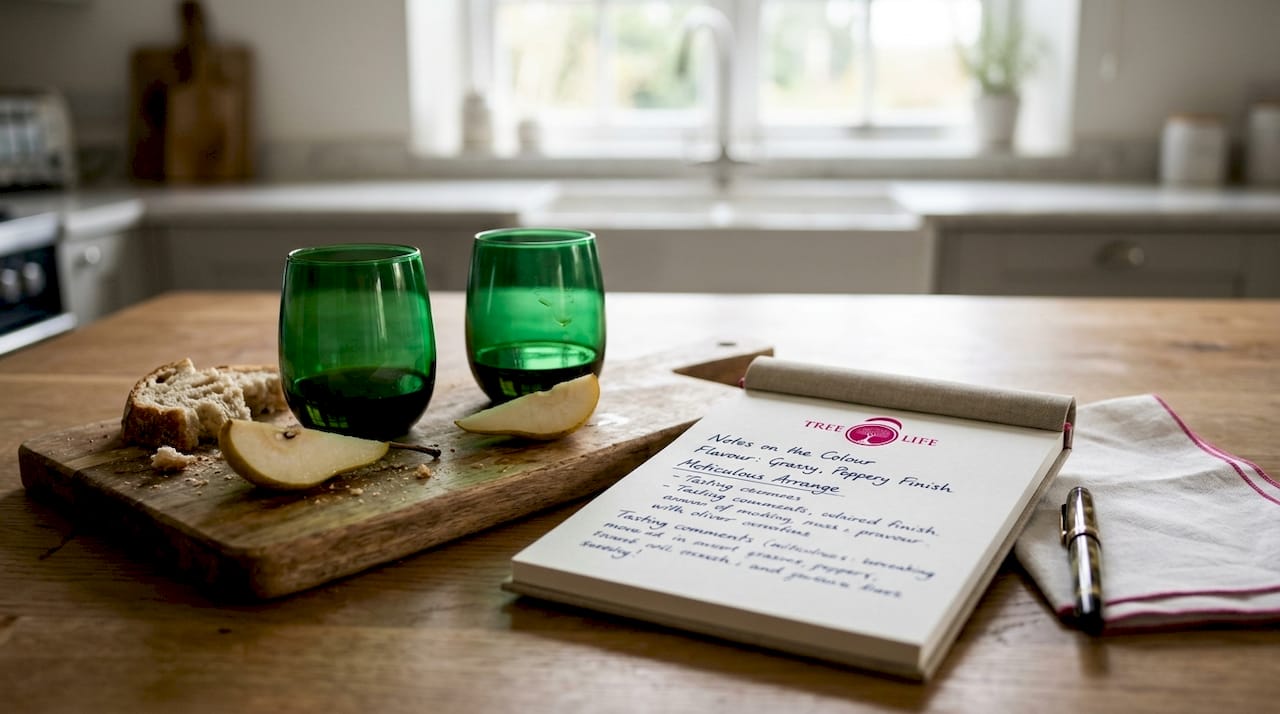
Avoid eating a heavy meal beforehand. Coffee, cigarettes, and mints within the hour before tasting will dull your palate noticeably. Wait at least 20 minutes after brushing your teeth.
| Tool or condition | Why it matters |
|---|---|
| Opaque or covered glass | Eliminates visual bias from oil colour |
| 15 ml oil per sample | Standard professional quantity for consistent evaluation |
| 20°C to 25°C room temperature | Prevents excessive warming or cooling that skews aromas |
| Neutral tasting environment | Removes competing scents that distort olfactory perception |
| Palate cleanser (water, apple, plain bread) | Resets your mouth between samples for accurate comparison |
Pro Tip: Smell your wrist before you start. If you can detect your hand cream or soap clearly, wash your hands with an unscented soap and wait a few minutes. Your hands will be cupping the glass throughout the tasting, and any strong scent will bleed directly into your assessment.
The step by step olive oil tasting process
This is where the real learning happens. The olive oil tasting process used by professional panels follows a clear sequence, and following it yourself produces dramatically better results than simply sipping and guessing.
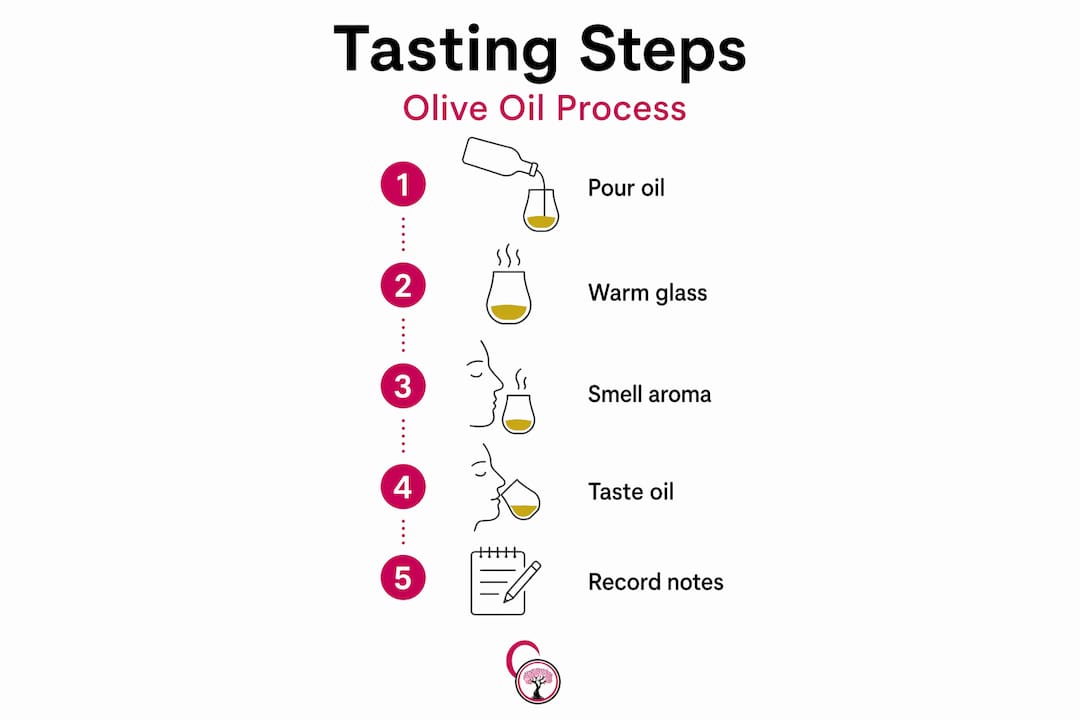
Pour and cover. Pour roughly 15 ml of oil into your glass and place the cover on top. Let it sit for one minute.
Warm the oil. Cup the glass between both palms and gently rotate it. Hold it like this for at least two minutes. Warming the oil releases volatile aromatic compounds that would otherwise stay locked in the liquid. This step is not optional. Skipping it means you will miss a significant part of the aroma profile entirely.
Smell the oil. Remove the cover and bring the glass close to your nose. Take one slow, deep breath. Do not sniff rapidly. You are looking for fruitiness first: does it smell of fresh olives, grass, green tomato, almonds, or ripe fruit? Then ask yourself whether there is anything unpleasant: a musty, vinegary, or stale smell. First impressions here are usually reliable.
Take a small sip. Draw about 5 ml into your mouth. Do not swallow immediately. Spread the oil across your entire tongue and the roof of your mouth. Notice the initial sensation: is it smooth, watery, thick, or coating?
Aspirate. This is the technique that separates structured tasting from casual sampling. With the oil still in your mouth, draw a short, sharp breath of air through slightly parted lips, as if you were cooling a hot spoonful of soup. This aspiration technique vaporises the oil, pushing aromatic compounds to the back of your nasal passage and activating trigeminal nerve receptors. The result is the characteristic peppery, throat-scratching sensation that indicates pungency in a quality oil.
Assess bitterness and pungency. Bitterness registers on the sides and back of the tongue. Pungency is the catch at the back of your throat, often arriving a second or two after swallowing. Both sensations come primarily from phenolic compounds such as oleocanthal and oleacein, which are markers of freshness and health-promoting antioxidant activity.
Note the finish. After swallowing, how long do the flavours linger? A quality oil holds its character for 10 to 20 seconds. A neutral or oxidised oil fades immediately.
Record your impressions. Write down your observations using simple descriptors. Intensity levels (mild, medium, intense), flavour notes (green apple, artichoke, almond, black pepper), and any defects. Professional panels rate fruitiness, bitterness, and pungency on a 0 to 10 scale, and you can use the same approach at home to track your progress.
Pro Tip: Compare at least two oils side by side during your first few sessions. Contrast is the fastest teacher your palate has. A mediocre oil placed next to a genuinely fresh, high-quality EVOO will reveal its weaknesses in under a minute.
Recognising attributes and defects
The three positive attributes
Fruitiness, bitterness, and pungency are the only positive sensory attributes used in official extra virgin olive oil evaluation. All three must be present in some form. Their absence or extreme imbalance signals either a low-grade oil or one that has deteriorated.
Fruitiness comes from healthy, fresh olives and manifests as pleasant green or ripe fruit aromas. Bitterness is a positive quality marker, not a flaw, even though many consumers initially dislike it. Pungency, that peppery sting in the throat, directly correlates with polyphenol content and therefore with the oil’s antioxidant health benefits.
Common defects to detect
Sensory defects arise from poor handling, storage, or processing and indicate chemical degradation. Recognising them is the single most valuable skill a home taster can develop.
| Defect | What it smells or tastes like | Common cause |
|---|---|---|
| Rancidity | Stale nuts, old wax crayons, paint | Oxidation from light, heat, or age |
| Fustiness | Fermented, swampy, earthy | Olives stored too long before pressing |
| Mustiness | Damp, mouldy, mushroomy | Fungal growth on damaged olives |
| Vinegary or winey | Sharp, acidic, like old vinegar | Fermentation during processing |
Any detectable sensory defect immediately disqualifies an oil from extra virgin classification. Not a reduced grade. Disqualification. That standard exists to protect consumers, and knowing what defects smell and taste like puts that protection directly in your hands.
Avoiding common tasting mistakes
Even attentive tasters fall into predictable traps. Being aware of them before you start is far more effective than diagnosing them afterwards.
- Trusting the label over your senses. Consumers often mistake marketing on “extra virgin” labels for a genuine quality marker rather than a technical classification. The sensory test is the only reliable check.
- Skipping palate cleansing between samples. Residual flavour from the previous oil will contaminate your impression of the next one. Always rinse with water and use a palate cleanser.
- Judging by colour. As noted earlier, colour carries no predictive value for quality. Over 21% of panel tests can incorrectly grade oils due to evaluation inconsistencies, and colour bias is one contributing factor.
- Tasting oils stored in poor conditions. An oil kept near your hob, in direct sunlight, or in a clear glass bottle may have degraded before you even open it. Always store in a dark, cool cupboard in a sealed dark container and taste fresh samples when evaluating quality.
- Dismissing bitterness as a flaw. Many first-time tasters note bitterness negatively when it is in fact a marker of quality. Train yourself to describe intensity rather than preference.
Pro Tip: If you want a more consistent baseline, check the harvest date on the bottle rather than the best-before date. Polyphenols degrade over time, and an oil from the current or most recent harvest will always outperform an older one, regardless of how it has been stored.
My honest take on why this matters
I have tasted dozens of olive oils, from supermarket blends to award-winning single-estate EVOO, and the gap between them is not subtle once you know what to look for. What surprises most people is not the complexity. It is how quickly their palate develops.
In my experience, the step by step tasting method stops feeling mechanical after just three or four sessions. You begin noticing things instinctively. A flat, watery oil that once seemed normal suddenly tastes obviously deficient. The peppery catch at the back of your throat starts to feel welcome rather than alarming.
What I find most interesting is the connection between sensory quality and health. Phenolic compounds that drive bitterness and pungency are exactly the same compounds responsible for the antioxidant benefits olive oil is celebrated for. An oil that tastes better on the palate genuinely is better for your body. The two are not separate conversations.
The skill of tasting also makes you a more discerning buyer. You stop relying on price as a proxy for quality and start trusting what your senses actually tell you. That is a genuinely useful skill to carry into any kitchen, market, or restaurant table.
— Mak
Put your new skills to work
Understanding the olive oil tasting process is only half the equation. The other half is having an oil worth tasting. If you have spent time working through this guide, you deserve to practise on something that genuinely rewards your attention.
Terracenturia specialises in high-polyphenol organic EVOO from Slovenian Istria, where traditional cultivation meets rigorous quality standards. Their oil is produced to maximise polyphenol content, which means the bitterness and pungency you will detect when tasting are not incidental. They are intentional, measurable, and indicative of genuine freshness and antioxidant richness.
For readers who want to deepen their understanding of what separates a good bottle from an exceptional one, the organic oil selection guide on the Terracenturia site covers the production and evaluation criteria in detail. When your palate is trained, the right oil makes all the difference.
FAQ
What glass should I use for olive oil tasting?
Use a small, opaque or dark-coloured glass to eliminate colour bias. Professional tasters use cobalt blue glasses for exactly this reason. Covering any glass with a card or foil also works.
How much oil should I taste at once?
Around 15 ml per sample is the standard used in professional panels. It is enough to assess aroma and taste without overwhelming your palate.
What does pungency mean in olive oil tasting?
Pungency is the peppery, stinging sensation felt at the back of the throat after swallowing. It is a positive attribute caused by oleocanthal and other phenolic compounds, and it signals a fresh, high-quality oil.
Can a defective oil still be labelled extra virgin?
Technically, no. Any detectable sensory defect such as rancidity, fustiness, or mustiness immediately disqualifies an oil from extra virgin classification under official evaluation standards.
How do I cleanse my palate between olive oil samples?
Use still water at room temperature and a small piece of plain, unsalted bread or a slice of green apple. Wait at least one minute before tasting the next sample to allow residual sensations to clear.