TL;DR:
- Gourmet olive oil is legally classified as high-quality EVOO with exceptional freshness, flavor complexity, and phenolic content.
- True quality depends on producer care, harvest timing, packaging, and transparent labeling, not just marketing terms.
Gourmet olive oil is an extra virgin olive oil distinguished by exceptional freshness, flavour complexity, and high phenolic content. The term “gourmet” carries no legal standing under EU regulation, which means the quality behind it rests entirely on the strict standards governing extra virgin classification combined with producer decisions about harvest timing, pressing, and packaging. Understanding what defines gourmet olive oil requires separating genuine quality markers from marketing language, and this guide covers both the regulatory framework and the sensory characteristics that matter most to culinary enthusiasts and health-conscious buyers in 2026.
What defines gourmet olive oil in legal and chemical terms
Extra virgin olive oil (EVOO) is the only grade that can credibly underpin a gourmet claim. Under EU regulation, EVOO is defined as a superior category oil obtained from olives solely by mechanical means, with a maximum free acidity of 0.8g per 100g. That mechanical extraction requirement is not a minor detail. It means no chemical solvents, no heat refining, and no blending with lower-grade refined oils. The oil you receive is, in effect, fresh olive juice.
Beyond acidity, the EU classification system sets chemical thresholds across several parameters that together determine whether an oil qualifies as extra virgin at all.
| Chemical parameter | EVOO maximum limit |
|---|---|
| Free acidity | 0.8 g/100g |
| Peroxide value | 20 mEq O₂/kg |
| K232 (UV absorbance) | 2.50 |
| K270 (UV absorbance) | 0.22 |
These figures matter because they measure oxidative damage and processing history. An oil with elevated peroxide values has already begun to degrade, regardless of how it is labelled. The K232 and K270 readings detect the presence of oxidation products that form when oil is exposed to heat, light, or air during production. A producer who harvests early, presses quickly, and stores carefully will consistently meet these thresholds with room to spare.
The critical point for buyers is this: “gourmet” is a marketing term with no EU regulated definition. Quality depends on genuine producer care at every stage, not on the word printed on the label. An oil can legally call itself gourmet while barely meeting the EVOO floor. Conversely, a producer who obsesses over harvest dates and cold pressing can deliver an oil that exceeds every chemical threshold by a wide margin. The grade is the floor; gourmet quality is what happens above it.
How do sensory qualities and phenolics define premium olive oil?
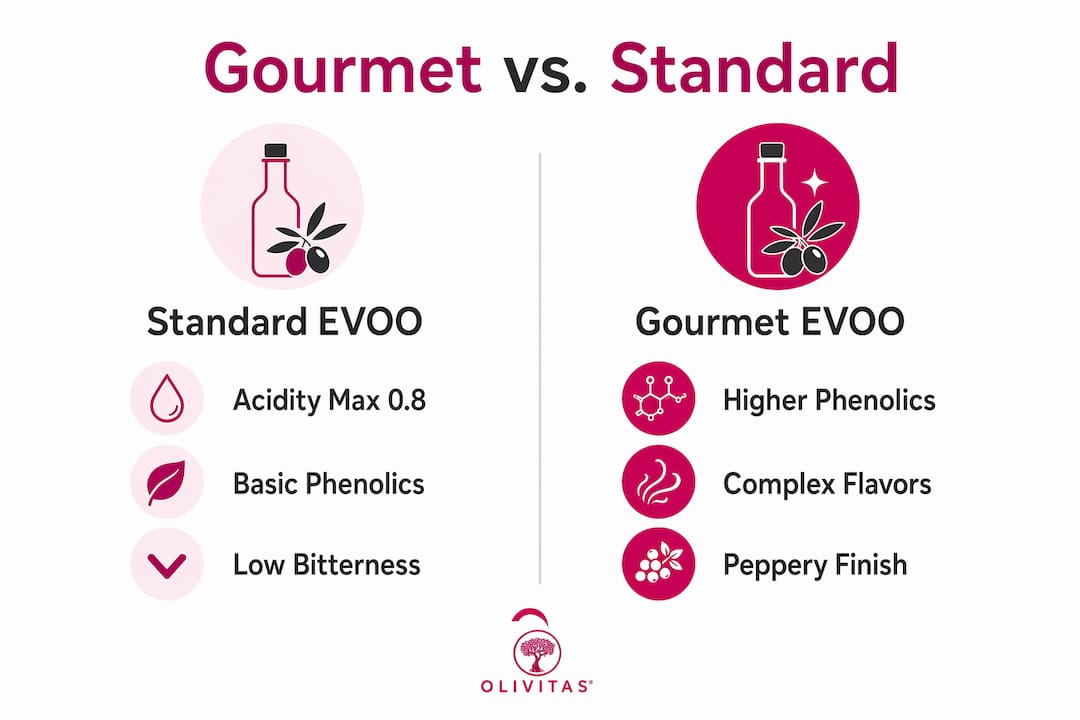
The characteristics of premium olive oil that elevate it beyond basic EVOO are sensory and biochemical. High-quality EVOO should show harmonious bitterness, pungency, and fruitiness, with fresh aroma notes including cut grass, green herbs, artichoke, and ripe stone fruit. These are not subjective preferences. They are measurable attributes assessed by trained panels under IOC (International Olive Council) protocols, and their absence or imbalance is classified as a defect.

Polyphenols sit at the centre of what makes olive oil gourmet from both a flavour and a health perspective. These naturally occurring antioxidants are responsible for the characteristic bitterness and the peppery finish that catches at the back of the throat. They also deliver the health benefits associated with regular EVOO consumption, including anti-inflammatory and cardioprotective effects. For health-conscious consumers, phenolic content paired with freshness is the foremost quality indicator, far more meaningful than a simple grade label.
Harvest timing shapes phenolic levels more than almost any other variable. Early harvest olives, picked when still green or turning colour, yield oils with higher polyphenol concentrations, more pronounced bitterness, and a sharper peppery finish. Late harvest oils, pressed from fully ripe olives, are softer and fruitier but carry fewer polyphenols. Neither profile is wrong, but for buyers prioritising polyphenol benefits, early harvest oils from single estates are the clearest path to gourmet quality.
Key sensory descriptors to look for in a genuinely premium oil include:
- Fruitiness: fresh, clean olive aroma with notes of green apple, tomato leaf, or almond
- Bitterness: a positive attribute indicating healthy phenolics, not a flaw
- Pungency: the peppery throat sensation caused by oleocanthal, a specific polyphenol with ibuprofen-like properties
- Aroma complexity: layered notes that evolve from first sniff to finish, rather than a flat or neutral smell
Pro Tip: If an olive oil has no bitterness or peppery finish whatsoever, it almost certainly lacks meaningful polyphenol content. That sensation is not a defect. It is the clearest sign of freshness and quality you can detect without a laboratory.
Does packaging affect gourmet olive oil quality?
Packaging is not a cosmetic choice. It is a quality decision that determines whether the sensory and chemical properties described above survive the journey from producer to your kitchen. Light and air exposure are the primary drivers of oxidative degradation in olive oil, and clear glass bottles accelerate that process significantly. A premium oil bottled in clear glass and displayed under shop lighting can lose meaningful phenolic content within weeks.
The preferred packaging types for preserving gourmet olive oil quality are dark glass, food-grade tins, and opaque ceramic vessels. Tins are particularly effective because they block light entirely and create a near-airtight seal. Dark glass offers good protection but is not impervious to light over extended periods. Ceramic is excellent for short-term storage and presentation but varies in seal quality.
Here is a practical checklist for evaluating packaging before you buy:
- Check the vessel material. Reject clear glass bottles unless the oil is stored in a dark environment. Prefer tins or dark glass.
- Look for a harvest date, not just a best-before date. Harvest date is the more reliable freshness indicator. Oils maintain peak flavour within 12 to 18 months unopened from harvest.
- Assess the seal. A proper cap or stopper that limits air contact after opening is a sign of a producer who understands oxidation.
- Avoid bulk or oversized containers unless you consume oil quickly. Once opened, degradation accelerates within weeks regardless of packaging quality.
- Treat heat as seriously as light. Oils stored near a hob or in a warm pantry degrade faster than those kept in a cool, dark cupboard.
Pro Tip: Once you open a bottle of premium EVOO, decant it into a smaller, airtight dark glass container if you will not finish it within three to four weeks. This simple step preserves far more of the flavour and phenolic content than leaving it in a half-empty original bottle.
Proper EVOO preservation is one of the most overlooked aspects of gourmet olive oil ownership. Buying well and storing poorly is a waste of both money and nutrition.
How to choose the best gourmet olive oil
Selecting a genuinely gourmet oil requires reading labels critically, trusting your senses, and understanding what certifications actually guarantee. Certification seals such as PDO (Protected Designation of Origin), PGI (Protected Geographical Indication), and COOC (California Olive Oil Council) provide reliable quality assurance. PDO certification, in particular, requires production from a defined geographical area using traditional methods, and the oil must pass both laboratory and sensory panel evaluation.
| Label feature | What it tells you |
|---|---|
| PDO or PGI seal | Verified origin and production method; sensory panel tested |
| Harvest date | Freshness indicator; prefer oils harvested within 12 months |
| Single estate or single variety | Traceability and flavour consistency; lower blending risk |
| Cold pressed or cold extracted | Mechanical process below 27°C; preserves phenolics and aroma |
| Polyphenol content (mg/kg) | Direct health and quality indicator; higher is generally better |
Single estate and single variety oils offer a level of traceability that blends cannot match. When you buy a Coratina from Puglia or a Leccino from Slovenian Istria, you know the olive variety, the growing conditions, and often the specific grove. Blended oils can be excellent, but they offer less transparency about origin and harvest timing.
Price is a genuine quality signal in this category, though not an infallible one. Authentic gourmet EVOO requires hand harvesting or careful mechanical harvesting at peak phenolic ripeness, rapid pressing within hours of harvest, and careful storage and packaging. These steps cost money. An oil priced at the same level as supermarket commodity olive oil is almost certainly not delivering gourmet quality, regardless of what the label claims.
The most reliable approach to evaluating olive oil quality combines label scrutiny with sensory assessment. Smell the oil before tasting. A flat, waxy, or rancid aroma signals degradation. A fresh, grassy, or fruity aroma signals quality. Then taste: bitterness and pungency are your friends. Emerging analytical techniques including spectroscopy and NMR are now being used by producers and researchers to authenticate gourmet claims and predict shelf life with greater precision, but your palate remains the most immediate tool available.
Key takeaways
Gourmet olive oil quality is defined by the combination of strict EVOO legal standards, high phenolic content, early harvest timing, and protective packaging. No single factor is sufficient on its own.
| Point | Details |
|---|---|
| Legal grade is the floor | EVOO classification sets the minimum; gourmet quality requires going well beyond it. |
| Phenolics signal both flavour and health | Bitterness and pungency indicate high polyphenol content, the primary marker of premium quality. |
| Harvest date beats best-before date | Look for oils harvested within 12 months; freshness preserves both flavour and antioxidants. |
| Packaging protects your investment | Dark glass, tins, or ceramic are the only acceptable vessels for preserving gourmet qualities. |
| Certifications add verified credibility | PDO, PGI, and COOC seals combine origin verification with laboratory and sensory testing. |
Why I think most buyers are still looking at the wrong things
Most people shopping for gourmet olive oil focus on the wrong signals. They look at the bottle design, the country of origin, or the price point. What they should be looking at is the harvest date and whether the oil has any bitterness at all.
I have tasted oils from celebrated Italian and Greek producers that were genuinely disappointing because they were bottled in clear glass, stored under shop lighting for months, and arrived at the consumer with almost no phenolic character remaining. I have also tasted oils from smaller, less famous producers in Slovenian Istria that were extraordinary because the producer harvested early, pressed within four hours, and bottled in tins with a clear harvest date printed on the label.
The 2026 regulatory updates have done useful work in tightening EVOO classification parameters, but they have not resolved the core consumer problem: the word “gourmet” still means nothing legally. What gives me confidence in an oil is transparency. A producer who tells you the harvest date, the variety, the polyphenol content in mg/kg, and the pressing method has nothing to hide. A producer who offers only vague descriptors like “artisanal” or “premium” almost certainly does.
The future of quality verification is genuinely exciting. Non-destructive analytical techniques like spectroscopy and NMR are moving from research labs into commercial production, meaning producers will soon be able to verify phenolic content and predict shelf life without opening a single bottle. That level of transparency will eventually reach the consumer label. Until it does, trust your nose, trust your palate, and trust producers who show their work.
— Mak
Discover Terracenturia’s high polyphenol EVOO from Slovenian Istria
If the standards described in this article represent what you are looking for, Terracenturia offers a direct answer. Their organic high polyphenol EVOO from Slovenian Istria is cold pressed from early harvest olives, with a documented polyphenol content of 1371 mg/kg, well above the EU threshold for a health claim. Every batch carries a clear harvest date, is bottled in protective packaging, and is produced without chemical intervention. For buyers who want what high phenolic EVOO actually delivers in terms of flavour and health benefit, Terracenturia’s range is a transparent, traceable starting point.
FAQ
What is the legal definition of extra virgin olive oil?
Extra virgin olive oil is defined by EU regulation as oil obtained from olives solely by mechanical means, with a maximum free acidity of 0.8g per 100g. It must also meet strict chemical thresholds for peroxide value and UV absorbance.
Is “gourmet olive oil” a regulated term?
No. “Gourmet” carries no legal definition under EU olive oil classification. Quality depends on the oil meeting genuine EVOO standards combined with producer decisions about harvest timing, pressing, and packaging.
What polyphenol level indicates a premium olive oil?
The EU authorises a health claim for olive oils containing at least 250 mg/kg of polyphenols. Genuinely high phenolic oils often exceed 500 mg/kg, with exceptional early harvest oils reaching above 1000 mg/kg.
How do I know if an olive oil is fresh?
Look for a harvest date rather than a best-before date. Oils are at peak quality within 12 to 18 months of harvest when unopened. A fresh, grassy aroma and a peppery finish on tasting are reliable sensory indicators of phenolic vitality.
What certifications should I look for when buying gourmet olive oil?
PDO and PGI seals verify geographical origin and production method under EU law. COOC certification combines laboratory and sensory panel evaluation. Any of these seals adds a layer of verified quality assurance beyond the producer’s own marketing claims.