TL;DR:
- Not all extra virgin olive oils provide the same health benefits, as phenolic content determines antioxidant power. High phenolic EVOO contains at least 250 mg of polyphenols per kilogram, supporting cardiovascular and metabolic health, unlike standard oils. Consumers should verify polyphenol levels through lab data, prioritize early harvest oils, and store in cool, dark places to maximize benefits.
Not all extra virgin olive oils deliver the same health benefits, even when the label says “extra virgin.” What separates a genuinely functional oil from a merely good-tasting one comes down to phenolic content. Understanding what is high phenolic EVOO means recognising that polyphenol concentration is the real measure of an oil’s antioxidant power and health value. Most shoppers overlook this entirely, choosing by colour or price rather than by the compounds that actually matter. This guide explains what defines a high phenolic EVOO, how to taste it, why it outperforms standard oils, and how to choose one worth buying.
Table of Contents
- Defining high phenolic extra virgin olive oil
- How polyphenols shape the taste and quality of EVOO
- Health benefits backed by high phenolic content
- Choosing and verifying authentic high phenolic EVOO
- Culinary uses and storage tips for high phenolic EVOO
- Rethinking high phenolic EVOO: beyond health hype and flavour
- Explore high phenolic EVOO with Terra Centuria
- Frequently asked questions
Defining high phenolic extra virgin olive oil
The term “high phenolic EVOO” is not marketing language. It has a precise scientific meaning. High phenolic EVOO is defined as extra virgin olive oil containing at least 250 mg of polyphenols per kilogram of oil, a threshold established through scientific literature and recognised by regulatory bodies.
Polyphenols are naturally occurring antioxidant compounds found in olives. They include hydroxytyrosol, tyrosol, and oleocanthal, among others. These molecules protect the oil from oxidation and, when consumed, exert protective effects in the body. The European Food Safety Authority (EFSA) has formally authorised a health claim for olive oil polyphenols, specifically linked to this 250 mg/kg threshold, acknowledging their role in protecting blood lipids from oxidative stress.

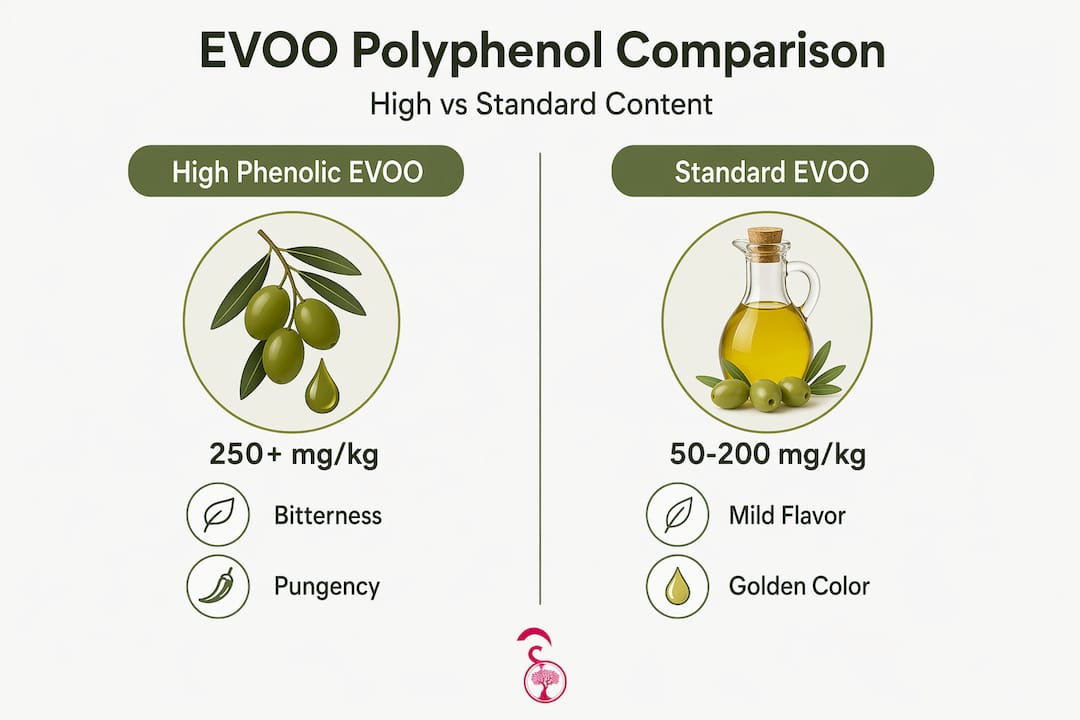
This threshold matters because most commercial extra virgin olive oils fall well below it. Standard EVOO can range from 50 to 200 mg/kg, which means it still contains polyphenols but at concentrations too low to trigger the measurable clinical effects seen in studies on high phenolic oils. Our high polyphenol olive oil guide breaks down these differences in detail if you want to explore further.
Key facts about what makes EVOO high phenolic:
- A minimum of 250 mg of polyphenols per kilogram is the accepted scientific threshold
- EFSA authorises a specific health claim tied to this polyphenol level
- Key polyphenols include hydroxytyrosol, oleocanthal, and oleuropein
- Polyphenol content varies with olive variety, harvest timing, and production method
- Early harvest and cold extraction typically yield higher polyphenol concentrations
How polyphenols shape the taste and quality of EVOO
Here is something that surprises many people: the very compounds responsible for high phenolic EVOO’s health properties are also the ones that make it taste sharp, bitter, and peppery. That throat-catching burn you feel after swallowing a quality extra virgin olive oil is oleocanthal at work. It is not a flaw. It is a signal.
Oils with higher total polyphenols generally show greater bitterness and pungency, and these sensory attributes also influence how the oil evolves during storage and daily use. This connection between flavour and function is one of the most useful things you can know as a consumer. A flat, mild, butter-smooth olive oil is almost certainly lower in polyphenols, regardless of what the label claims.
That said, taste alone cannot confirm polyphenol levels. Bitterness can come from other compounds, and some high phenolic oils are more restrained in flavour depending on olive variety. The polyphenols role in EVOO taste is genuinely complex, which is why sensory assessment must always be paired with lab data for certainty.
Sensory characteristics associated with high phenolic content:
- Strong, persistent bitterness on the mid-palate
- Peppery finish with a noticeable throat sensation
- Green, grassy, or artichoke-like aromas
- Longer flavour persistence compared to lower phenolic oils
- Better resistance to going rancid during storage
Pro Tip: When tasting an oil for the first time, hold it in your mouth for five seconds before swallowing. A genuine high phenolic EVOO will produce a distinct peppery sensation at the back of the throat. No pepper, no phenols worth writing home about.
Health benefits backed by high phenolic content
The advantages of high phenolic EVOO over standard EVOO are not subtle. They are measurable, documented, and increasingly clinically significant. Polyphenols are the primary drivers of olive oil’s cardioprotective reputation, and their concentration determines how potent those effects are.
Research confirms that HP-EVOO improves inflammation, glycemic control, oxidative stress markers, and endothelial function, with potential protection against metabolic syndrome and cardiovascular disease. These findings go well beyond what standard EVOO trials demonstrate, positioning high phenolic content as the critical variable rather than the fat profile of the oil itself.
High phenolic EVOO is not just a better version of a common ingredient. At verified polyphenol levels, it functions as a genuinely bioactive food, with documented effects on inflammatory pathways, blood glucose regulation, and vascular health that standard olive oils do not reliably replicate.
The health benefits of high phenolic olive oil extend across several systems in the body. Oleocanthal, for example, inhibits the same inflammatory enzymes targeted by ibuprofen, which explains why regular consumers of high phenolic oils often report reduced joint stiffness. Hydroxytyrosol is one of the most potent antioxidants in the human diet by weight.
Documented benefits of high phenolic content in olive oil include:
- Reduced markers of systemic inflammation
- Improved glycemic control in people with insulin resistance
- Lower levels of oxidative stress measured through blood biomarkers
- Support for endothelial function and vascular flexibility
- Protection of LDL cholesterol from oxidation
It is worth noting that not every claimed benefit has equal evidence. HDL cholesterol maintenance, for instance, is frequently cited but lacks the same level of clinical backing. The high phenolic EVOO health benefits page provides a detailed breakdown of what the evidence actually supports.
Choosing and verifying authentic high phenolic EVOO
Knowing the benefits is only useful if you can identify the real thing on a shop shelf or website. This is where most consumers get stuck, because the olive oil market has a well-documented transparency problem. “Extra virgin” is frequently misrepresented, and phenolic content claims are rarer still.
How to choose high phenolic EVOO with confidence:
- Look for labelled polyphenol content. Seek out oils that state polyphenol levels in mg/kg or as hydroxytyrosol equivalents. This is the single most reliable indicator.
- Check the harvest date, not just the best-before date. Polyphenols degrade over time. An oil bottled more than 18 months ago will have lost significant phenolic content regardless of its original level.
- Prioritise early harvest oils. Olives picked before full ripeness contain considerably higher polyphenol concentrations. Many producers will state “early harvest” or “green harvest” on the label.
- Verify through third-party testing. Producers who publish independent lab certificates are demonstrating genuine accountability. If the numbers are not available, be sceptical.
- Use sensory cues as supporting evidence. Bitterness and pungency remain useful signals, but only lab quantification confirms a high phenolic level beyond doubt.
Pro Tip: Ask producers directly for their polyphenol analysis results. A reputable producer will share them without hesitation. If the response is vague or unavailable, that tells you something important.
| Feature | High phenolic EVOO | Standard EVOO |
|---|---|---|
| Polyphenol content | 250 mg/kg or above | Typically 50 to 200 mg/kg |
| EFSA health claim | Authorised | Not applicable |
| Flavour profile | Bitter, peppery, persistent | Mild, smooth, neutral |
| Oxidative stability | Higher | Lower |
| Harvest timing | Early harvest preferred | Mixed |
| Lab data availability | Should be provided | Rarely provided |
Our organic EVOO quality evaluation guide covers additional markers to look for when assessing any extra virgin olive oil.
Culinary uses and storage tips for high phenolic EVOO
High phenolic EVOO performs best when used in ways that preserve its polyphenol content. The good news is that the best culinary uses for this oil also happen to be where it shines most as an ingredient.
Raw applications are ideal. Drizzle it over grilled vegetables, whisk it into dressings, finish a soup just before serving, or use it as a dipping oil with good bread. The flavour is complex enough to carry a dish without other seasoning. Its bitterness pairs beautifully with bitter greens like rocket or radicchio, where contrasting intensity creates balance rather than competition.
For cooking, low to moderate heat is fine. High phenolic EVOO offers greater oxidative stability than standard oils, meaning it holds up better during gentle cooking. Extended high-heat frying will degrade polyphenols, so save your best oil for the table rather than the frying pan.
Storage guidelines to protect your investment:
- Store in a dark glass bottle or tin, away from light sources
- Keep at a consistent cool temperature, ideally between 14°C and 18°C
- Seal tightly after each use to minimise air exposure
- Avoid storing near the cooker, where heat fluctuates daily
- Use within 12 months of harvest for peak phenolic content
Pro Tip: Pairing high phenolic EVOO with bitter, acidic, or umami-rich foods amplifies its flavour complexity. A drizzle over grilled sardines with lemon, or stirred into a bean stew just before serving, produces an entirely different eating experience from a mild oil. Explore recipes and wine pairing ideas to get the most from the oil’s flavour profile, and visit our page on ways to use EVOO for practical inspiration.
Rethinking high phenolic EVOO: beyond health hype and flavour
There is a framing problem in how high phenolic EVOO is typically discussed, and it is worth addressing directly. Most content treats it either as a gourmet luxury or as a supplement alternative. Neither framing is quite right, and both lead consumers to misuse it.
The more accurate way to think about it comes from the research itself. HP-EVOO functions as a higher dose delivery system for polyphenols rather than as a categorically different food. The clinical effects seen in studies depend on actual polyphenol intake, which means the concentration in the oil matters enormously but so does how much you use daily and how regularly. Drizzling one teaspoon of a 600 mg/kg oil once a week does not produce the same outcome as using two tablespoons of a 300 mg/kg oil every day.
This has a practical implication that rarely gets stated plainly: buying the highest polyphenol oil on the market is less important than consistently using a genuinely verified high phenolic oil at meaningful volumes. Regularity and confirmed quality beat extremity of concentration.
The second issue is the sensory assessment myth. Bitterness is a useful signal but an unreliable guarantee. We have seen oils with genuinely impressive phenolic credentials that taste relatively restrained due to olive variety, and we have tasted aggressively bitter oils that labs confirm are nowhere near the 250 mg/kg threshold. Taste informs, but it does not certify.
Finally, the issue of producer transparency deserves more consumer attention than it gets. Phenolic content is measurable, affordable to test, and straightforward to communicate. Producers who do not publish their data are not necessarily hiding anything, but they are not giving you the information you need to make a genuinely informed choice. Sustainability, traceability, and polyphenol benefits in olive oil are all interconnected. The producers who prioritise one tend to prioritise all three.
Explore high phenolic EVOO with Terra Centuria
If you want to move from reading about high phenolic EVOO to actually tasting and using it, Terra Centuria’s range of organic, lab-certified oils from Slovenian Istria offers a genuinely transparent starting point. Every oil comes with verified polyphenol data, produced through early harvest and cold extraction methods that consistently yield concentrations well above the 250 mg/kg threshold. Visit Terra Centuria to browse the current selection, and use the high polyphenol olive oil guide to understand what the numbers on each label actually mean. For those who want to understand the process behind the bottle, the organic olive oil selection process explains every step from grove to glass.
Frequently asked questions
What is considered a high phenolic level in extra virgin olive oil?
High phenolic EVOO contains at least 250 mg of polyphenols per kilogram of oil, meeting the threshold recognised by EFSA for authorised health claims related to olive oil polyphenols.
Does bitterness always mean olive oil is high in polyphenols?
Bitterness and pungency are strong indicators of polyphenol presence, but only laboratory analysis can definitively confirm whether an oil meets the 250 mg/kg high phenolic threshold.
What health benefits are associated with high phenolic EVOO?
High phenolic EVOO has been shown to improve inflammation, glycemic control, and oxidative stress markers, with evidence suggesting meaningful reduction in cardiovascular and metabolic risk beyond what standard EVOO provides.
How should I store high phenolic EVOO to maintain quality?
Store it in a cool, dark place in a tightly sealed container. Oils with higher initial phenolic levels retain their antioxidants better during daily use, but heat, light, and air will still degrade them over time.
Can high phenolic EVOO be used for cooking?
Yes, particularly for raw applications, drizzling, and low-heat cooking where its antioxidants and complex flavour remain intact. High-heat frying is best avoided if you want to preserve both the polyphenol content and the sensory qualities.