TL;DR:
- Limited edition olive oils feature documented provenance, early harvests, and artisanal production, making them distinct from mass-market blends. They offer higher polyphenol content, complex flavors, and verified health benefits, with proper storage preserving their quality. Consumers should seek lab certificates and transparency to ensure authenticity and maximize their investment.
Most people pick up a bottle of extra virgin olive oil at the supermarket without a second thought. Same shelf, similar labels, seemingly interchangeable. But there is a category of olive oil that bears almost no resemblance to those mass-produced blends, and understanding why limited edition olive oil exists as a distinct product changes how you think about what you are actually pouring on your food. This article breaks down what separates these oils from the ordinary: the provenance, the harvest timing, the flavour complexity, and the tangible health advantages that come from doing things the slow, careful, small-batch way.
Table of Contents
- Key takeaways
- Why limited edition olive oil is genuinely different
- Flavour and health benefits of early harvest oils
- Artisan sourcing and sustainable cultivation
- How to use and store limited edition olive oil
- My take on where limited edition olive oil is heading
- Discover Terracenturia’s limited batch EVOO
- FAQ
Key takeaways
| Point | Details |
|---|---|
| Transparent labelling matters | Genuine limited edition oils list harvest year, bottle counts, and mill-lot numbers to confirm authenticity. |
| Early harvest drives quality | Olives picked before peak ripeness yield higher polyphenols, lower acidity, and more complex flavour profiles. |
| Artisan production is deliberate | Small-batch producers prioritise purity and character over volume, monitoring every stage of cultivation. |
| Sustainability is part of the value | Regenerative farming and precision agriculture protect soil health and oil integrity over the long term. |
| Storage determines shelf quality | Dark glass, cool conditions, and minimal air exposure are non-negotiable for preserving limited edition oils. |
Why limited edition olive oil is genuinely different
Walk into a gourmet food shop and you will likely see bottles that claim to be premium. But documented provenance is what separates a credible limited edition oil from a marketing exercise. Collectors and serious buyers look for harvest reports, laboratory analysis certificates, and mill-lot numbers that tie a specific bottle to a specific grove, season, and pressing. Without these, “limited edition” is just a label.
What does genuine documentation look like in practice? A credible bottle will carry the harvest year clearly stated, not buried in small print. It will specify the number of bottles produced in that run. Some producers now include digital provenance tokens, which let you verify the oil’s origin on your phone. Label art and limited runs are also part of the picture, transforming bottles into objects that collectors display rather than simply consume.
The production philosophy is equally significant. Limited batch olive oil is produced with artisanal methods that prioritise purity and character over volume, with obsessive attention to detail at every stage. That means hand or careful mechanical harvesting at precise windows, cold pressing within hours of picking, and small-tank storage that prevents cross-contamination of flavour profiles. Each of these steps adds cost and time but directly determines the quality of what ends up in the bottle.
What makes this different from mass-market production is not sentiment. It is structure. Large-scale olive oil processing blends olives from multiple regions, presses in bulk, and prioritises consistency and shelf stability over complexity. Limited edition producers are making entirely different decisions.
- Harvest year printed on every bottle, not just a general “best before” date
- Mill-lot numbers linking the oil back to a specific press run and grove
- Bottle counts declaring exactly how many units were produced in that release
- Laboratory certificates showing polyphenol content, acidity, and peroxide levels
- Harvest reports detailing weather conditions, olive variety, and pick dates
Pro Tip: When evaluating a limited edition olive oil, request or look for the lab certificate online before purchasing. A producer confident in their oil will always make this publicly available.
Flavour and health benefits of early harvest oils
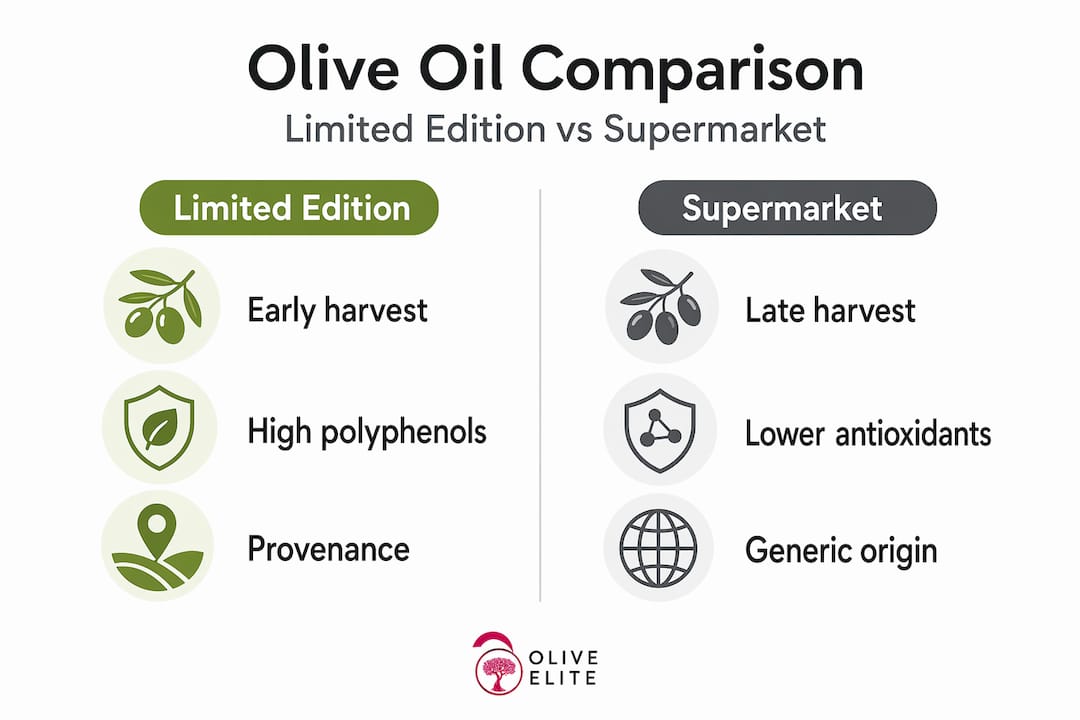
The timing of the harvest is where limited edition oils gain their biggest advantage. Olives harvested early, before they reach full ripeness, contain substantially more polyphenols. Early harvest olives produce oil with lower acidity, stronger antioxidants, and a flavour profile that carries genuine complexity: grassy, peppery, sometimes bitter in the most appealing way. That peppery finish at the back of your throat is oleocanthal, a compound with demonstrated anti-inflammatory properties.
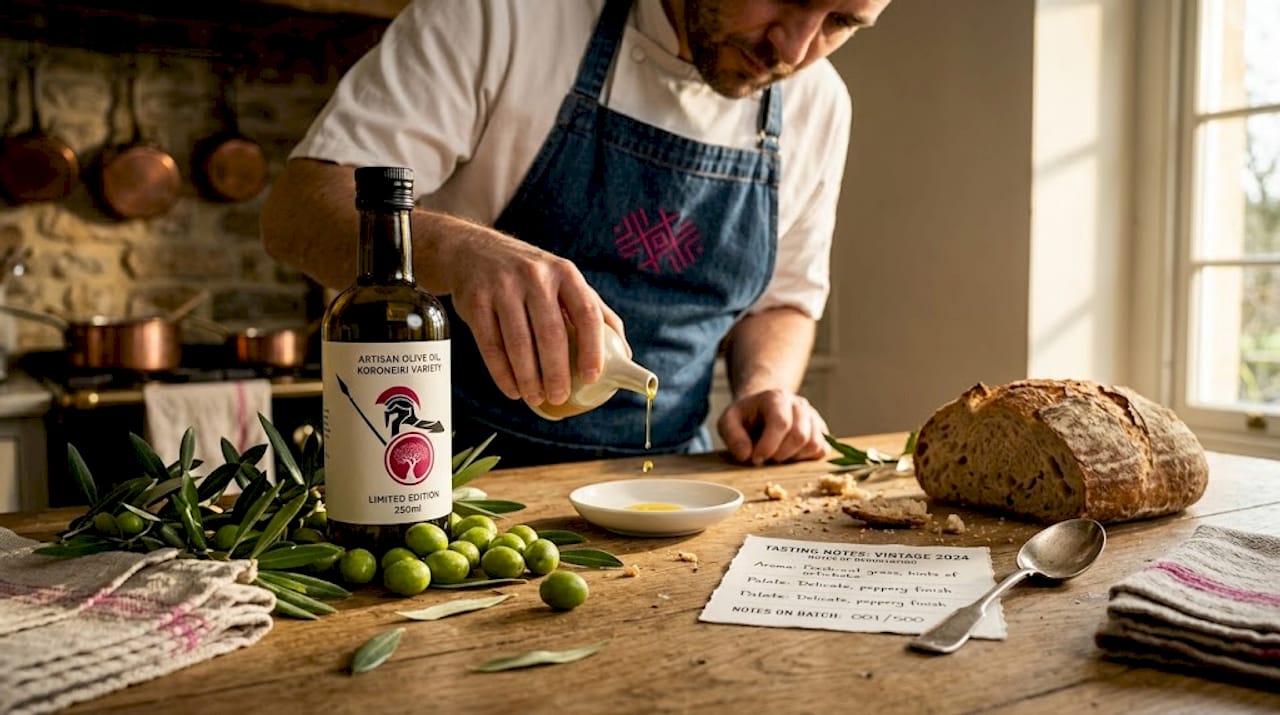
Compare that with the typical supermarket bottle, which is often made from riper olives pressed later in the season, when yield is higher but polyphenol content has declined naturally. The difference is not subtle.
| Characteristic | Limited edition (early harvest) | Standard supermarket EVOO |
|---|---|---|
| Polyphenol content | High (often 400 mg/kg or above) | Low to moderate (often below 150 mg/kg) |
| Acidity level | Very low (below 0.3%) | Typically 0.3–0.8% |
| Flavour profile | Fresh, grassy, peppery, complex | Mild, neutral, sometimes flat |
| Harvest timing | Early, pre-ripeness peak | Late season for higher yield |
| Health credentials | Lab-certified antioxidant levels | Rarely individually tested |
Terroir plays a meaningful role here too. The microclimate of a specific grove, the mineral composition of its soil, and even the prevailing winds during flowering will shape what ends up in the oil. This is why a monovarietal oil from a single grove in Slovenian Istria tastes entirely different from one pressed from the same variety grown two hundred kilometres away. Limited editions capture a specific place and moment in time.
Pro Tip: If you want to experience the peppery, antioxidant-rich profile of a genuine early harvest oil, pour a small amount into a spoon and taste it neat before cooking. This tells you more about its quality than any label.
Artisan sourcing and sustainable cultivation
The limited batch olive oil advantages do not stop at the bottle. They extend back through the entire supply chain, to groves managed with a precision and care that would be economically impossible at industrial scale. Artisan producers apply continuous monitoring, precision agriculture, and long-term land stewardship that treats each tree as an individual rather than a unit of production.
Regenerative farming practices are increasingly common among serious limited edition producers. This means returning organic matter to the soil, minimising tillage, using cover crops between rows, and applying targeted rather than blanket treatments. The result is healthier soil biology, stronger trees, and olives with greater natural resilience and more concentrated flavour compounds. You can learn more about how artisanal production methods translate directly into quality at the pressing stage.
“The future of premium olive oil lies with producers who combine traditional wisdom with scientific precision and a luxury hospitality mindset.” Source: Theonios Traditional Olive Groves
Sustainability certifications add a further layer of consumer trust. Organic certification, for instance, means no synthetic pesticides or herbicides were used in the grove, which directly protects the delicate aromatic compounds in the olive. When an oil carries both an organic certification and documented lab results, you have two independent sources of verification rather than one producer’s word.
- Precision agriculture tools track individual tree health and soil moisture
- Mulching and cover crops reduce erosion and improve water retention
- Targeted treatments replace blanket pesticide application
- Organic certification provides third-party verification of growing practices
- Long-term land stewardship preserves grove productivity across generations
How to use and store limited edition olive oil
Knowing the benefits of limited edition olive oil is one thing. Getting the most from a bottle is another. These oils are built for showcasing, not for deep-frying. Used correctly, they transform simple dishes into something memorable.
- Finish, do not cook. Drizzle limited edition oil over a finished dish rather than heating it. A good Slovenian Istrian EVOO over grilled fish, a bowl of soup, or a plate of burrata reveals flavours that would be lost at high temperatures.
- Pair with neutral bases. The oil should be the star. Plain bread, mild cheese, and simple vegetables let the grassy, peppery complexity of an early harvest oil speak for itself.
- Use it for health-conscious dressing. The antioxidant-rich properties of high-polyphenol oils make them particularly well suited to salads and raw preparations where the compounds remain fully intact.
- Give it as a gift. Packaging design, bottle rarity, and artisan provenance make limited editions genuinely collectible. A well-chosen bottle with a certificate of authenticity is a gift that signals genuine thought and knowledge.
- Store it properly. Dark glass, cool conditions, and limited air exposure are critical for preserving the freshness and flavour complexity of a limited edition oil. Keep it away from direct sunlight and heat sources, and seal it tightly after each use.
The shelf life of even a premium EVOO is typically twelve to eighteen months from pressing. With a limited edition oil that you have invested in specifically for its flavour and polyphenol content, using it within that window is not just advice. It is the whole point.
My take on where limited edition olive oil is heading
I have followed premium food markets for long enough to see real patterns emerge, and what is happening with limited edition olive oils reminds me closely of what happened with natural wine fifteen years ago. A small group of obsessive producers, a slowly growing audience willing to pay for authenticity, and then a tipping point.
What I find genuinely interesting is the parallel with fine wine as an appreciating asset. Limited edition oils with lab reports, harvest documentation, and digital provenance verification are increasingly treated not just as food but as collectible objects with verifiable provenance. That is a significant cultural shift for a product most people still buy without looking at the label.
My caution is this: the success of the category will attract imitators. Not every bottle that claims to be limited edition will have the documentation to back it up. Consumers seeking transparency and health credentials over brand name are right to be sceptical, and asking for the lab certificate is the single most effective filter I know. If a producer cannot provide one, the price premium is marketing, not substance.
The producers I respect most are the ones who treat every harvest as a distinct event worth documenting, where what makes olive oil special is not a vague claim about tradition but a specific set of numbers: polyphenol count, acidity, bottle run, harvest date. That level of precision is what separates a meaningful limited edition from a beautifully packaged ordinary bottle.
— Mak
Discover Terracenturia’s limited batch EVOO
If the provenance, polyphenol content, and artisan sourcing described in this article are what you are looking for, Terracenturia offers exactly that. Produced in Slovenian Istria from organically farmed groves, Terracenturia’s high-polyphenol organic EVOO is harvested early, cold-pressed, and documented with full laboratory analysis. The range includes monovarietal releases built around traceability and distinct flavour integrity. For those who want to understand the organic selection process behind each bottle, the website offers detailed guides alongside the products themselves. If you are ready to taste what a genuinely premium limited edition oil delivers, Terracenturia is the place to start.
FAQ
What makes a limited edition olive oil genuinely special?
Genuine limited edition olive oils are produced in small batches with documented provenance, including harvest year, mill-lot numbers, and laboratory-certified polyphenol levels. These qualities are traceable and verifiable, setting them apart from mass-market blends.
Are the health benefits of limited edition olive oil real?
Yes. Early harvest olives used in limited editions yield oils with significantly higher polyphenol concentrations, which are linked to antioxidant activity and heart health support. The difference in polyphenol content between an early harvest artisan oil and a standard supermarket EVOO is measurable in lab analysis.
How should I store a limited edition olive oil?
Store it in dark glass, away from light and heat, and seal it tightly after each use. Proper storage preserves both the flavour complexity and the polyphenol content that justify the investment in a premium bottle.
Can limited edition olive oil be used as a gift?
Absolutely. The combination of artistic packaging, documented rarity, and artisan provenance makes limited edition oils a genuinely prestigious gift for food lovers, wellness-conscious consumers, and collectors alike.
How do I know if a limited edition olive oil is authentic?
Ask for or find the laboratory certificate showing polyphenol content, acidity, and peroxide values. A credible producer will always make this available. If the documentation is absent, the premium price is not supported by evidence.