TL;DR:
- Olive oil awards are based on sensory evaluations within specific style categories, not as universal rankings.
- Most medals reflect quality and style recognition assessed by expert panels, not a single overall winner.
When you spot a gold medal on an olive oil bottle, you might assume it’s simply the best oil on the shelf. That assumption, while understandable, misses the full picture. Explaining olive oil awards properly means unpacking a layered system of sensory categories, tasting panels, and style-based recognition that most shoppers never see. The world of olive oil quality recognition is far richer than a single podium, and once you understand how it works, you will never buy an award-winning oil the same way again.
Table of Contents
- Key takeaways
- How olive oil awards work
- Major competitions compared
- What awards mean when you are buying
- Behind the scenes of competition success
- My take on decoding olive oil awards
- Discover award-worthy olive oils from Slovenian Istria
- Common questions
Key takeaways
| Point | Details |
|---|---|
| Awards reflect style categories | Medals are given within fruitiness and style categories, not as a single universal ranking. |
| Sensory panels decide everything | Expert tasting panels assess defects and organoleptic qualities that chemical tests cannot capture. |
| Many oils win medals | Hundreds of oils receive medals at major competitions, signalling broad quality rather than one winner. |
| Monovarietals outperform blends | Single-variety oils win at a notably higher rate than blends in international competitions. |
| Match medals to your cooking | Use award categories to identify oils suited to your taste and culinary application. |
How olive oil awards work
At the heart of every serious olive oil competition is sensory evaluation. Known formally as organoleptic assessment, this method relies on trained human tasters rather than laboratory instruments alone. A panel of expert judges evaluates each oil blind, meaning they taste from dark glasses so colour does not influence their judgement. They assess positive attributes such as fruitiness, bitterness, and pungency, while also checking rigorously for defects.
Sensory defects such as rancidity, mustiness, or fustiness are the primary reasons oils fail to achieve extra virgin classification, even when their chemistry looks fine on paper. This is a critical point: chemical tests measure acidity and peroxide levels, but they cannot catch the full spectrum of sensory flaws that a trained palate detects instantly. An oil can pass every lab test and still taste of damp hay or old cardboard because of poor storage or late harvesting.
A prominent example of institutional benchmarking is the IOC’s Mario Solinas Quality Award. The 2026 edition evaluated 123 EVOO samples over four days with an international jury assessing both defects and organoleptic quality. Crucially, the award categories are organised by fruitiness intensity and producer type rather than producing a single “best oil” ranking. Robust, medium, and delicate fruitiness each receive separate recognition, which means a light Ligurian oil and a punchy Koroneiki are never directly competing against each other.
Pro Tip: When reading competition results, always check which fruitiness category an award was given in. A gold medal in the “delicate” category tells you something very different from a gold in the “robust” category, even if both medals look identical on the bottle.
Understanding olive oil judging at this level changes how you interpret labels. It transforms a gold sticker from a simple quality stamp into a flavour signal.
Major competitions compared
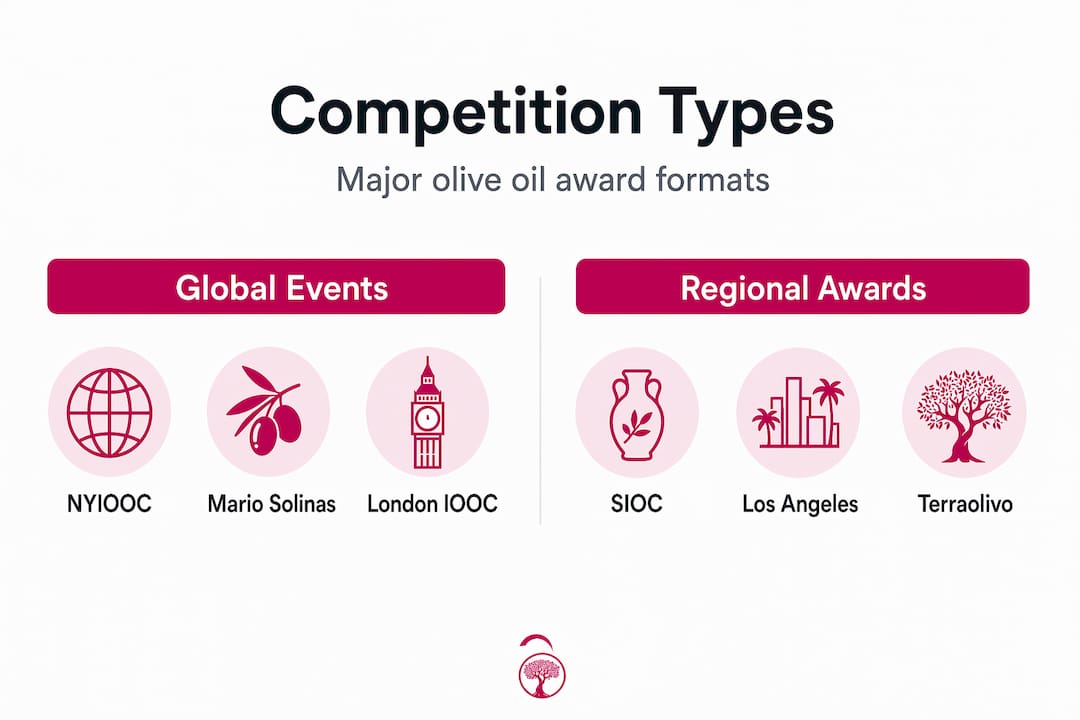
The landscape of international olive oil competitions is broad, from vast open contests to tightly focused regional awards. Understanding the olive oil competition details across the major players helps you weigh medals more accurately.
| Competition | Scale and focus | Award structure |
|---|---|---|
| NYIOOC World Olive Oil Competition | 1,021 oils from 29 countries in 2026 | Gold and Silver medals based on blind panel scores |
| IOC Mario Solinas Quality Award | Institutional benchmark, ~123 samples | Categories by fruitiness intensity and producer type |
| EVOOLEUM Awards | European-focused, high-end market positioning | Top 100 ranking plus category medals |
| Terraolivo | Israel-based, global entries | Grand Prestige Gold, Gold, and Silver tiers |
The NYIOOC is the largest of these by volume. At the 2026 competition, blind panels awarded 464 Gold and 234 Silver medals from over a thousand entries. That scale matters for interpretation. When nearly half of all entries receive a gold medal, the medal signals that an oil has passed a serious quality threshold within its category. It does not mean it defeated all other entrants in a head-to-head final.
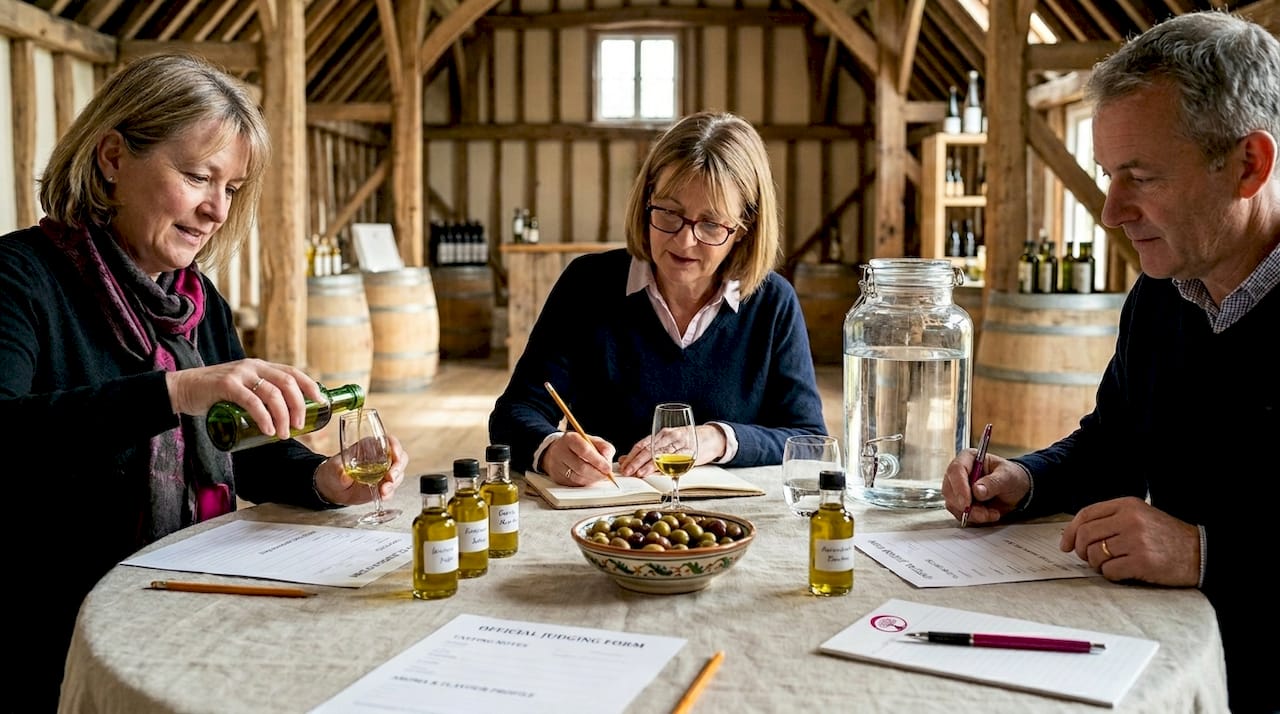
Small and medium-sized producers regularly earn medals alongside much larger companies, which reflects the genuinely democratic nature of these competitions. A family estate in Slovenian Istria competes on equal sensory terms with a large Spanish cooperative. The panel does not know who made the oil. It only knows what it tastes like.
The types of olive oil accolades also vary between competitions in ways that matter to consumers. Some competitions use Gold, Silver, and Bronze tiers. Others use a pass/fail Gold threshold. A few focus on named styles such as robust versus delicate fruitiness or early versus late harvest. Each framework reflects different priorities, which is why reading the competition’s own criteria is worth five minutes of your time.
What awards mean when you are buying
Here is where explaining olive oil awards becomes genuinely practical. The key insight is this: awards reflect excellence within styles, not a universal hierarchy. Once you accept that, medals become a genuinely useful tool for selecting oils rather than a confusing parade of gold stickers.
A sensible approach to using awards when shopping looks like this:
- Identify the competition. A medal from the NYIOOC, IOC Mario Solinas, or EVOOLEUM carries more interpretive weight than a lesser-known regional contest with few entries and opaque judging criteria.
- Check the category. Robust, medium, or delicate fruitiness? Early harvest or ripe fruit? These distinctions tell you whether the oil matches what you are actually looking for in the kitchen.
- Note the varietal or blend status. At the 2026 NYIOOC, monovarietals achieved a 78% success rate compared to 63% for blends. This does not mean blends are inferior, but it does suggest that single-variety oils often present more clearly defined flavour profiles that sensory panels reward consistently.
- Match the medal to your use case. A robust, intensely peppery oil with a gold medal is brilliant over a Tuscan ribollita or with strong cheeses. A delicate silver-medal oil from Arbequina olives might be your first choice over vanilla ice cream or in a mayonnaise.
- Use awards as a shortlist, not a verdict. The distribution of Gold, Silver, and Bronze medals reflects diverse quality levels and taste profiles. Buy small bottles of three award-winning oils in different categories and taste them side by side. Your own palate is the final judge.
Pro Tip: Look for producers who win consistently across multiple harvests. A single medal might reflect one exceptional year. A producer who earns recognition year after year is demonstrating the kind of process discipline that translates into reliably excellent oil. You can learn more about evaluating oil quality yourself to sharpen these judgements.
Behind the scenes of competition success
Winning olive oil brands do not simply submit their best bottle and hope for the best. The path to a medal begins months before harvest and continues through every stage of production. Consistency across seasons is what separates genuinely great producers from those who strike lucky once.
Several factors quietly determine whether an oil earns a medal or fails at the sensory panel stage:
- Harvest timing. Oils pressed from olives picked too late develop ripe fruit notes that some categories reward, but they also risk oxidation and lower polyphenol content. Early harvest oils retain more bitterness and pungency but require precise technique to avoid grassy defects.
- Milling speed. Delaying milling after harvest, even by a few hours in warm conditions, allows fermentation to begin inside the fruit. The resulting fustiness is one of the most common defects detected by tasting panels and is an immediate disqualifier at every serious competition.
- Storage conditions. Even a perfect oil can develop rancidity if stored in warm temperatures, exposed to light, or kept in poorly sealed containers. Many producers invest as heavily in their storage infrastructure as in their milling equipment.
- Consistency across seasons. Harvesting, milling, and storage practices directly determine competition success from one year to the next. A producer who won three years ago but cut corners on this harvest may find that a panel’s sensitive noses detect exactly what changed.
Chemical analysis alone does not guarantee award success. Even producers with impeccable reputations occasionally submit oils that fail sensory evaluation due to a single batch stored incorrectly or a delay in harvest during an unexpected warm spell. The rigour of these panels is precisely what makes their recognition meaningful.
My take on decoding olive oil awards
I have spent a good deal of time around serious olive oil, from visiting producers in Istria to sitting through professional tastings where the differences between oils were genuinely revelatory. And the single most common mistake I see from food enthusiasts is reaching straight for the gold medal without asking what it means.
Most people read a gold medal the way they read a restaurant star rating, as a single score that places one thing above another. But in olive oil competitions, a gold in the delicate category and a gold in the robust category are recognising fundamentally different flavour achievements. Comparing them is like comparing a first-class riesling with a first-class barolo. Both excellent. Not the same thing at all.
What I have found genuinely transformative is developing a basic vocabulary for sensory description. You do not need formal training. You need to slow down, stop swallowing instantly, and notice what happens thirty seconds after the oil hits the back of your throat. That late peppery bite is the oleocanthal your body is reacting to. It signals polyphenol richness, and it is what award panels reward in the robust category. Learning to taste olive oil properly shifts your relationship with every oil you buy.
My practical advice is this: use awards as your introduction to a category, then do your own tasting. A gold-medal oil in a style that doesn’t suit your palate or your cooking is still the wrong choice. But a silver-medal oil in the exact style you love is a find worth going back to.
— Mak
Discover award-worthy olive oils from Slovenian Istria
If this article has sharpened your appetite for genuinely outstanding oil, Terracenturia offers a direct route to experiencing what award-level quality actually tastes like. Their high polyphenol organic EVOO from Slovenian Istria is produced with the same attention to harvest timing, milling speed, and storage that the best competition entrants prioritise. With polyphenol content reaching 1,371 mg/kg, it represents exactly the kind of early-harvest, intensely bioactive oil that earns recognition at the highest levels.
For those who want to go deeper, Terracenturia’s guide to the organic selection process explains the quality criteria that align closely with what international judging panels look for. Start there, then taste for yourself.
Common questions
What do olive oil competition medals actually measure?
Medals recognise excellence within specific sensory categories, assessing both positive attributes like fruitiness and bitterness, and the absence of defects such as rancidity or mustiness. They do not identify a single “best” oil across all entries.
Why do so many oils win gold medals at the NYIOOC?
At the 2026 NYIOOC, over 460 gold medals were awarded because the competition recognises every oil that reaches a defined quality threshold within its category, rather than selecting only one winner per class. High performance is common among serious producers.
Do monovarietal oils win more often than blends?
Yes. At the 2026 NYIOOC, single-variety oils achieved a success rate of 78% compared to 63% for blended oils, likely because their cleaner flavour profiles are easier for sensory panels to assess and reward within defined categories.
How should I use awards when choosing an olive oil to buy?
Identify the competition, check the style category (robust, medium, or delicate), and match that profile to your intended use. Treat medals as a quality shortlist, then use your own tasting to make the final call.
Can an oil pass chemical tests but still fail at competitions?
Yes. Defect detection through sensory analysis remains the primary hurdle for many oils. An oil can meet all chemical standards for acidity and peroxide levels yet still be disqualified by a tasting panel that detects mustiness or rancidity.