TL;DR:
- Most “extra virgin” olive oils on shelves fail to meet strict international chemical and sensory standards, leading to potential mislabeling. Regional bodies like COOC and NAOOA enforce tighter criteria, ensuring higher quality and freshness, unlike the lax enforcement of global guidelines. Verifying certifications, harvest dates, and practicing sensory evaluation help consumers identify truly high-quality, health-supporting oils.
Most bottles labelled “extra virgin” on supermarket shelves are lying to you. Not through outright fraud, but through a system where labelling requirements are loosely enforced and quality thresholds vary dramatically by region. Defining extra virgin standards is not a matter of marketing language — it is a precise, internationally governed process combining chemical analysis and trained sensory evaluation. Understanding these criteria changes how you shop, what you taste, and ultimately what your body absorbs.
Table of Contents
- What extra virgin means: international chemical and sensory standards
- Comparing stricter regional standards: California and North America
- The role of sensory evaluation in defining true extra virgin quality
- Why stricter acidity limits and freshness matter for health benefits
- How to verify extra virgin olive oil quality at purchase and home
- Why simply trusting the label on your extra virgin olive oil is not enough
- Trust Terra Centuria for authentic high-polyphenol extra virgin olive oil
- Frequently asked questions
Key Takeaways
| Point | Details |
|---|---|
| Combined standards matter | True extra virgin olive oil quality depends on both chemical metrics and sensory evaluation by trained panels. |
| Stricter local limits | California and North American standards require lower free acidity and tighter freshness controls than international norms. |
| Sensory defects disqualify | Any detectable sensory defects mean the oil cannot be legally classed as extra virgin. |
| Freshness preserves health | Lower acidity and harvest date labelling help preserve antioxidants essential for health benefits. |
| Verify before buying | Look for official seals, harvest year, and taste characteristics to confirm authentic extra virgin quality. |
What extra virgin means: international chemical and sensory standards
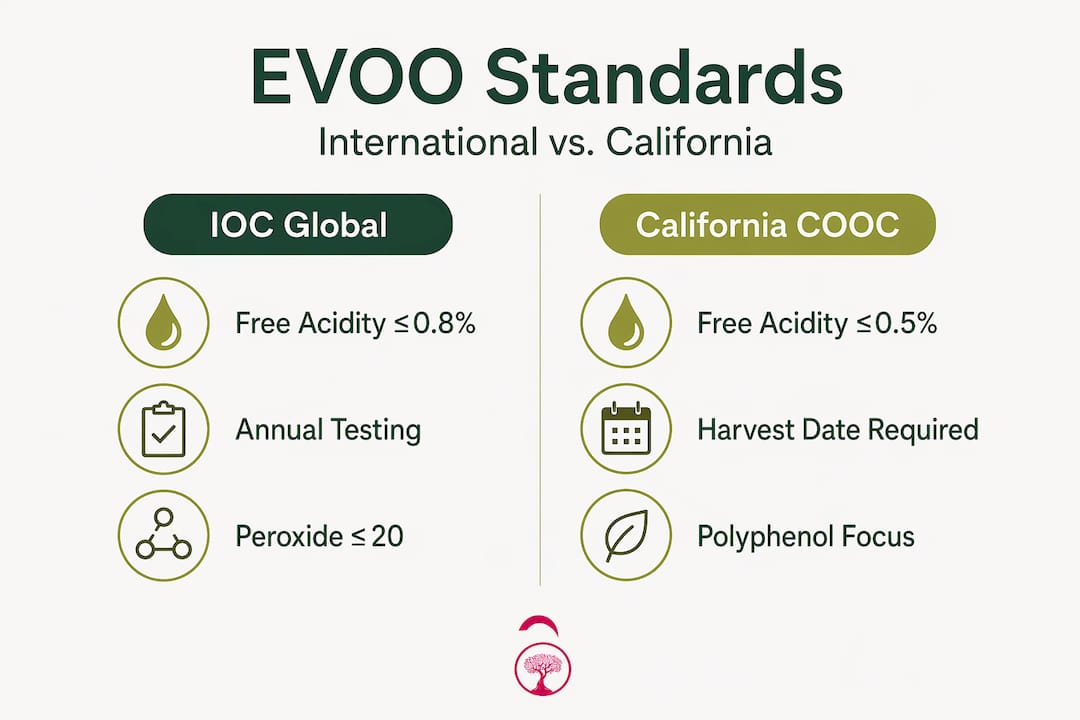
The International Olive Council (IOC) sets the global benchmark for extra virgin olive oil criteria, and the thresholds are specific. According to IOC standards, extra virgin olive oil must meet free acidity ≤0.8%, peroxide value ≤20 meq O₂/kg, UV absorbance K232 ≤2.50 and K270 ≤0.22, and pass sensory evaluation with a median defect score of zero and fruitiness above zero. These are not suggestions. Fail any single parameter and the oil cannot legally carry the extra virgin designation.
Here is what each chemical marker actually tells you:
- Free acidity measures the breakdown of fatty acids, caused by poor harvesting, damaged fruit, or delayed processing. Lower is fresher.
- Peroxide value indicates early-stage oxidation. High peroxide means the oil has already begun deteriorating, even if it smells fine.
- UV absorbance (K232 and K270) detects secondary oxidation compounds invisible to the nose and palate.
- Sensory score confirms what chemistry cannot fully capture: the presence of defects like rancidity, mustiness, or fermentation, and the positive attributes that signal a living, fresh oil.
| Parameter | IOC extra virgin limit |
|---|---|
| Free acidity | ≤0.8% |
| Peroxide value | ≤20 meq O₂/kg |
| UV absorbance K232 | ≤2.50 |
| UV absorbance K270 | ≤0.22 |
| Median defect score | 0 (none detectable) |
| Median fruitiness | >0 |
The sensory component is where most consumers are surprised. Sensory panels and defect detection involve blind tastings by 8 to 12 trained evaluators who assess oils against a defined vocabulary of defects and positive attributes. An oil that passes chemistry but smells rancid is still disqualified. Both gates must be cleared.

Pro Tip: When reading an olive oil label, look for the harvest date rather than just the best-before date. An oil bottled in 2024 with a 2027 best-before date tells you almost nothing about freshness. A harvest date of October 2025 tells you everything.
Comparing stricter regional standards: California and North America
Beyond global IOC standards, some regions apply even tighter criteria to ensure superior oil quality and freshness. The California Olive Oil Council (COOC) is one of the most demanding certification bodies in the world. COOC standards require free acidity ≤0.5%, peroxide value ≤15 meq O₂/kg, and UV K270 ≤0.22 for 100% California-grown oils, with mandatory annual chemical and sensory testing. That 0.5% acidity ceiling is not arbitrary — it reflects the reality that well-handled oils from healthy fruit, pressed within hours of harvest, routinely achieve acidity below 0.3%.
The North American Olive Oil Association (NAOOA) has similarly tightened its framework. NAOOA updated standards now set free acidity at ≤0.5%, limit best-by dates to 18 months from bottling, and require mandatory facility audits alongside increased testing frequency. These changes directly address the problem of aged or poorly stored oils entering the market under the extra virgin banner.
| Standard body | Free acidity limit | Peroxide value limit | Annual testing | Shelf life limit |
|---|---|---|---|---|
| IOC (global) | ≤0.8% | ≤20 meq O₂/kg | Not mandated | Not specified |
| COOC (California) | ≤0.5% | ≤15 meq O₂/kg | Required | Not specified |
| NAOOA (North America) | ≤0.5% | IOC-aligned | Required | 18 months from bottling |
What this comparison reveals is important. The IOC baseline is a floor, not a quality target. Oils that just scrape under 0.8% acidity are technically extra virgin, but they are unlikely to deliver the flavour complexity or polyphenol density that makes this category worth paying for.
- Stricter acidity limits reward producers who harvest early and process quickly.
- Annual testing prevents producers from certifying once and coasting on reputation.
- Origin labelling requirements under COOC and NAOOA reduce blending of lower-quality oils into certified bottles.
- The 18-month shelf life rule from NAOOA forces retailers to rotate stock rather than sell old oil at a premium price.
Understanding differences in extra virgin standards across certification bodies gives you a clearer picture of what a seal actually guarantees. Not all certifications are equal.
Pro Tip: If you see a COOC seal on a bottle, you are looking at one of the most rigorously verified extra virgin designations available. The annual retesting requirement means the certification is not a one-time stamp.
The role of sensory evaluation in defining true extra virgin quality
To truly grasp what makes an oil extra virgin, it is essential to appreciate how sensory evaluation confirms chemical tests. Chemistry tells you what is wrong with an oil. Sensory evaluation tells you whether it is genuinely good.
IOC sensory evaluation methods require that trained panels detect no defects with a median score above zero and confirm positive attributes including fruitiness, bitterness, and pungency, all assessed blindly by 8 to 12 tasters. The process is more structured than most people realise.
- Warming the sample. Oil is poured into a dark blue glass and warmed to 28°C to release volatile aromatic compounds without revealing colour, which could bias tasters.
- Olfactory assessment. Tasters inhale slowly and assess for any of 16 defined defects, including rancid, fusty, muddy sediment, winey, and metallic notes.
- Gustatory assessment. A small amount is taken into the mouth and spread across the palate. Bitterness and pungency are scored as positive attributes, not flaws.
- Recording and aggregation. Each taster scores independently. The median score across the panel determines classification.
- Classification decision. If any defect median exceeds zero, the oil is downgraded regardless of its chemical profile.
“Bitterness and pungency are not defects in extra virgin olive oil. They are direct indicators of polyphenol content. An oil that tastes aggressively peppery at the back of the throat is telling you it is rich in oleocanthal, a compound with anti-inflammatory properties comparable to ibuprofen at culinary doses.”
This is the detail most consumers miss entirely. The throat catch you feel when swallowing a high-quality oil is not a sign of poor quality. It is a sign of exceptional quality.
Why stricter acidity limits and freshness matter for health benefits
Understanding the chemical and sensory standards leads us to why stricter acidity limits and freshness labels matter for your health. The connection between low acidity and high antioxidant content is not coincidental — it reflects the entire production philosophy.
COOC experts on acidity note that the stricter 0.5% limit reflects superior handling within hours of harvest, preserving higher antioxidant levels including oleocanthal compared to oils produced under IOC’s 0.8% ceiling. Every hour between harvest and pressing is an hour during which enzymatic activity breaks down polyphenols and elevates acidity. Producers who achieve consistently low acidity are not just meeting a number — they are demonstrating rigorous control over their entire supply chain.
The polyphenol picture is equally important. Polyphenols at 250 mg/kg or above provide oxidative stability and anti-inflammatory effects, but these compounds decline over time, making harvest date within 18 months a critical freshness indicator. Oils with polyphenol content above 400 mg/kg are genuinely functional foods, not simply cooking fats.
- Low acidity (below 0.3%) signals fast, careful processing and high polyphenol retention.
- High polyphenol content (above 250 mg/kg) provides measurable anti-inflammatory and cardioprotective benefits.
- Harvest date labelling allows you to calculate whether the oil is still within its peak nutritional window.
- Proper storage after purchase is equally critical — heat, light, and air degrade polyphenols rapidly.
“An oil with 500 mg/kg polyphenols stored next to a cooker for six months will deliver fewer health benefits than a 300 mg/kg oil stored correctly in a dark tin and used within weeks of opening.”
Learn more about polyphenols and health benefits to understand why polyphenol density is the single most important quality measure for health-conscious buyers.
Pro Tip: If an oil does not display a harvest date, treat it as a yellow flag. Producers with nothing to hide about freshness always show it.
How to verify extra virgin olive oil quality at purchase and home
With knowledge of standards and health impact, you can apply practical methods to verify quality when buying and storing extra virgin olive oil. The process is simpler than it sounds once you know what to look for.
- Check for official certification seals. IOC recognition, COOC certification, or NAOOA membership signals that the oil has been independently tested, not just self-labelled.
- Read the harvest date, not just the best-by date. You want oil from the most recent harvest, ideally within 12 months of purchase.
- Look for origin and cultivar information. Single-origin oils from named cultivars (Leccino, Frantoio, Buga) are traceable and harder to adulterate than blended “Mediterranean” oils.
- Smell and taste before you commit. Fresh extra virgin oil smells of cut grass, green tomato, artichoke, or ripe fruit depending on cultivar. Any hint of crayons, old nuts, or vinegar is a defect.
- Store correctly from day one. Use a dark glass bottle or tin, keep it away from heat and light, and finish it within three weeks of opening.
Sensory evaluation and verified certification are your two most reliable tools for identifying genuinely fresh, high-quality extra virgin olive oil. Everything else is secondary.
For a thorough walkthrough of what to check, the olive oil quality verification tips at Terra Centuria cover both label reading and at-home sensory assessment in practical detail.
Pro Tip: Dark tin containers are superior to dark glass for long-term storage. They block all light, not just most of it, and maintain a more stable internal temperature.
Why simply trusting the label on your extra virgin olive oil is not enough
Here is the uncomfortable reality. The standards exist. The science is clear. And yet up to 70% of imported “extra virgin” oils fail basic chemical and sensory standards when independently tested. That figure is not a fringe finding — it has been replicated across multiple studies and continues to surface despite growing consumer awareness.
The problem is not that producers are universally dishonest. It is that enforcement is inconsistent, import testing is sporadic, and the extra virgin label carries enormous commercial value with relatively low accountability in many markets. An oil can be legitimately certified in its country of origin and then degrade during shipping and storage before it reaches your shelf. It still carries the label.
Simple home tests are also far less reliable than popular articles suggest. The refrigeration test — the idea that real extra virgin oil solidifies in the fridge — is a myth. Solidification depends on fatty acid composition, not quality. Colour tells you almost nothing about grade. Even aroma assessment requires training to be meaningful.
What actually works is a combination of verified certification from bodies with annual retesting requirements, transparent harvest date labelling, and developing your own sensory vocabulary through tasting. The more oils you taste with attention, the faster you identify the difference between a genuinely fresh, polyphenol-rich oil and one that has been sitting in a warehouse since the previous harvest.
Evaluating olive oil quality is a learnable skill. The investment is small and the return — in flavour, health, and confidence — is significant. Treat it the same way you would approach wine or cheese. The label is a starting point, not a guarantee.
Trust Terra Centuria for authentic high-polyphenol extra virgin olive oil
If this article has made one thing clear, it is that the gap between a certified extra virgin olive oil and a genuinely exceptional one is wide. At Terra Centuria, every bottle of high-polyphenol organic EVOO from Slovenian Istria comes with full transparency about harvest date, cultivar, origin, and independent polyphenol testing. There is no blending, no ambiguity, and no gap between the label and what is inside. The organic olive oil selection process reflects the same rigorous standards this article has described, applied to every single harvest. If you want to put the knowledge you have gained here into practice, the olive oil evaluation guide is a practical next step.
Frequently asked questions
What chemical criteria must extra virgin olive oil meet?
Extra virgin olive oil must have free acidity ≤0.8%, peroxide value ≤20 meq O₂/kg, UV absorbance K232 ≤2.50 and K270 ≤0.22, as defined by the International Olive Council, alongside passing sensory evaluation with no detectable defects and positive fruitiness.
Why do some regions have stricter extra virgin standards?
Regions like California enforce free acidity ≤0.5% and require annual retesting to guarantee fresher, higher-antioxidant oils, going well beyond the IOC baseline to ensure superior quality and health benefits for consumers.
How important is sensory evaluation in confirming extra virgin quality?
Sensory evaluation by trained panels is essential because it confirms the absence of defects and the presence of positive attributes like fruitiness, bitterness, and pungency that chemistry alone cannot fully verify.
What should consumers look for on an extra virgin olive oil label?
Look for official certifications, harvest year, cultivar, and country of origin. Key quality markers on a label include harvest date and IOC-recognised certification, which together confirm freshness and authenticity.
How should extra virgin olive oil be stored at home to maintain quality?
Store EVOO in dark glass or tin, in a cool and dark place, and use it within three weeks of opening to preserve polyphenols and prevent oxidation from degrading both flavour and health properties.