
TL;DR:
- Olive oil quality is defined by chemical metrics and sensory evaluation according to IOC standards.
- Labeling details like harvest year, cultivar, and certification provide more reliable quality indicators than price or color.
- Proper sensory assessment and verified certification help consumers identify fresh, high-quality extra virgin olive oil.
The label on most olive oil bottles tells you very little about what’s actually inside. Marketing words like “pure,” “natural,” and even “extra virgin” are widely misused, leaving health-conscious consumers guessing. The good news is that EVOO quality standards are defined by the International Olive Council (IOC) using both chemical analysis and sensory evaluation, and you can apply much of that framework yourself. This guide walks you through the real indicators of quality, the tools you need, a step-by-step evaluation process, and the most common mistakes people make when choosing olive oil.
Table of Contents
- What determines olive oil quality?
- Tools and prerequisites for evaluating olive oil
- Step-by-step guide: Assessing olive oil quality
- Common pitfalls and how to verify results
- Why most olive oil advice falls short—and what actually works
- Discover authentic olive oils and expert resources
- Frequently asked questions
Key Takeaways
| Point | Details |
|---|---|
| IOC standards matter | True EVOO quality is defined by International Olive Council laboratory and sensory benchmarks. |
| Ignore color and price | Color and price are unreliable indicators; focus instead on certifications and transparent labels. |
| Sensory evaluation rules | Taste, smell, and texture are your best tools for identifying quality olive oil and spotting defects. |
| Verify with trusted sources | Look for certified oils with harvest year and cultivar, and avoid unverified or misleading packaging. |
| Common tests fail | Home tests like refrigeration and visual color checks do not reliably indicate olive oil quality. |
What determines olive oil quality?
Olive oil quality is not a matter of opinion. It is defined by measurable chemical parameters and trained sensory evaluation, both governed by the IOC trade standard. Understanding these two pillars gives you a reliable framework for judging any bottle.
On the chemical side, the IOC chemical benchmarks for true extra virgin olive oil are specific: free acidity must be at or below 0.8% oleic acid, peroxide value at or below 20 meq O2/kg, UV absorbance K232 at or below 2.5, and K270 at or below 0.22. The median defect score must equal zero, and the fruitiness median must be greater than zero. These are not arbitrary numbers. They reflect the oil’s freshness, oxidation level, and processing integrity.
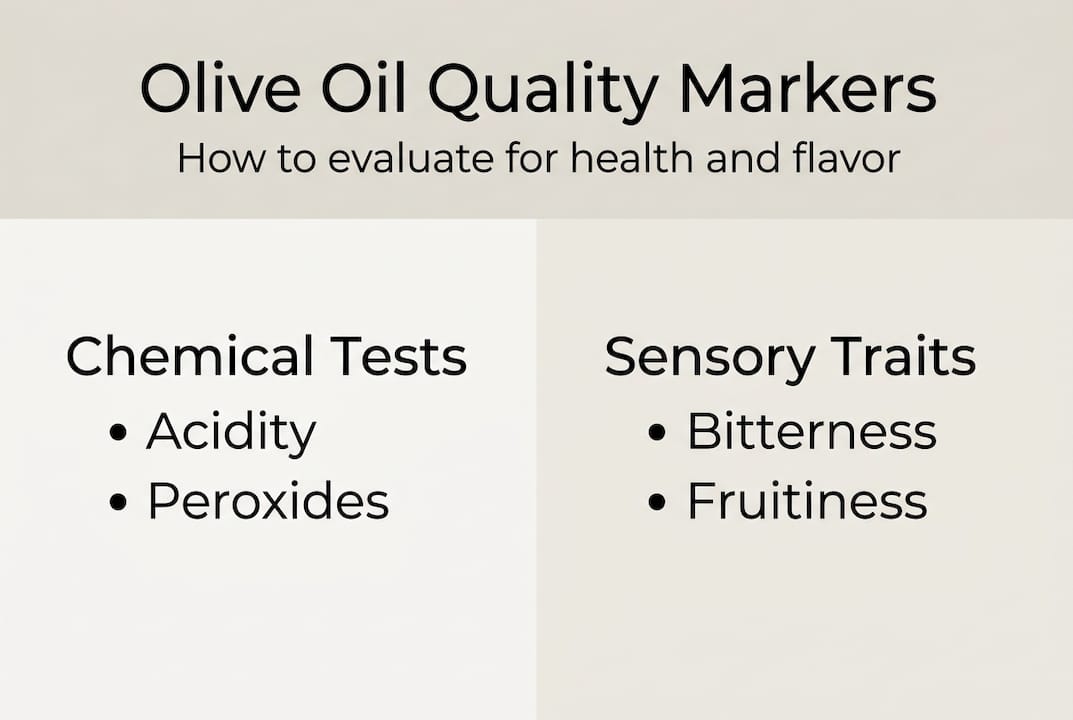
Sensory analysis is the other half of the equation. A trained IOC panel evaluates olive oil for positive attributes like fruitiness, bitterness, and pungency, while also detecting defects such as rancidity, mustiness, and a metallic taste. An oil that passes chemical tests but fails sensory evaluation cannot legally be called extra virgin.
One of the most persistent myths is that color signals quality. It does not. Olive oil naturally ranges from deep green to pale yellow depending on the cultivar, harvest timing, and filtration. A bright green oil is not inherently better than a golden one. Chlorophyll content affects color, not quality.
Here is a quick comparison of the main olive oil grades:
| Grade | Free acidity | Defect median | Fruitiness |
|---|---|---|---|
| Extra virgin | ≤0.8% | 0 | >0 |
| Virgin | ≤2.0% | ≤3.5 | >0 |
| Ordinary virgin | ≤3.3% | ≤6.0 | >0 |
| Lampante | >3.3% | >6.0 | N/A |
Key quality markers to look for on a label include:
- Harvest year (freshness indicator)
- Cultivar or variety (traceability)
- Country and region of origin
- IOC-recognized certification
- Lab analysis or panel test results
For a deeper look at how these markers connect to health outcomes, the olive oil quality markers guide covers the science behind each parameter. If you want a broader framework, the quality evaluation guide is a useful starting point.
Tools and prerequisites for evaluating olive oil
Knowing the standards is one thing. Actually applying them requires the right setup. The good news is that you do not need a laboratory to make an informed judgment.
For sensory evaluation at home, you need a few simple items:
- A dark blue or opaque glass (to prevent color bias during tasting)
- Warm water and plain bread for palate cleansing between samples
- Two or three reference oils for side-by-side comparison
- A quiet, odor-free environment so you can focus on subtle aromas
- A printed or digital copy of the IOC sensory wheel to help name what you detect
A basic home lab kit, including tools to measure acidity or peroxide values, is impractical for most consumers. Those tests require reagents, controlled conditions, and trained interpretation. What you can do reliably is sensory evaluation and label verification.
Label reading is underrated. A bottle that lists the harvest year, the specific cultivar, the region of origin, and references an IOC-recognized panel test is already telling you more than most oils do. Transparency on a label is itself a quality signal.
Two popular home tests are worth addressing directly. The refrigerator test, where people chill olive oil to see if it solidifies, is completely unreliable. As authentication research confirms, all olive oils solidify when cold because of their natural fat composition. This test tells you nothing about quality or purity. Similarly, color is irrelevant across the green-to-yellow spectrum and should never factor into your evaluation.
Old or oxidized oil is easier to spot. It smells and tastes waxy, flat, or like crayons. That crayon-like note is a classic sign of rancidity caused by high peroxide values from oxidation. If an oil smells like that, no label claim can save it.

Pro Tip: Warm the tasting glass in your hands for about 30 seconds before smelling the oil. This releases volatile aromatic compounds and makes defects much easier to detect.
For a hands-on walkthrough of the tasting process, the olive oil tasting guide is an excellent resource. If you want to understand how producers screen oils before they reach you, the selection process overview explains exactly that.
Step-by-step guide: Assessing olive oil quality
With your tools ready, here is how to evaluate an olive oil from start to finish.
- Check the label first. Look for a harvest year, a named cultivar, a specific region of origin, and any IOC certification. Missing all of these is a red flag before you even open the bottle.
- Inspect the bottle visually. Dark glass or opaque packaging is a good sign. Light degrades olive oil quickly. Clarity matters too. A slightly hazy oil may simply be unfiltered, which is fine. Sediment in a supposedly filtered oil is not.
- Pour a small amount into a dark glass. Ignore the color entirely. Warm the glass in your palms for 20 to 30 seconds.
- Smell the oil slowly. Positive aromas include fresh-cut grass, green tomato, artichoke, almond, and ripe fruit. Negative aromas include mustiness, vinegar, rancidity, and metallic notes.
- Taste a small sip. Let it coat your entire mouth. Quality EVOO will have a peppery finish at the back of the throat, which signals polyphenol content. Bitterness on the tongue is also a positive attribute, not a flaw.
- Note the texture. Good EVOO feels clean and fluid. Greasy or heavy texture can indicate lower quality or blending.
- Compare side by side. Tasting two or three oils together sharpens your ability to detect differences.
On price: retail quality studies show that price does not correlate with quality. Many mid-range and low-priced EVOOs fail both sensory and chemical tests despite their labels, while some affordable oils from transparent producers perform well. Focus on what the label tells you, not what the price implies.
“A high price tag does not guarantee extra virgin status. Transparent labeling with harvest year and cultivar is a far more reliable predictor of quality.”
For a full breakdown of what separates premium oils from average ones, the premium olive oil criteria article is worth reading. If you are specifically looking for high-polyphenol options, the polyphenol olive oil guide covers what to look for.
Common pitfalls and how to verify results
Even careful buyers get misled. Here are the most common traps and how to sidestep them.
Misleading visual cues. Attractive packaging, dark bottles with gold labels, and premium-looking fonts signal nothing about what is inside. Design is marketing. Quality is chemistry and sensory truth.
Trusting price alone. As empirical retail data confirms, price is not a reliable proxy for quality. Some of the worst-performing oils in retail studies carried premium price tags.
Ignoring label red flags. Watch out for:
- No harvest year listed
- Vague origin like “Product of multiple EU countries”
- No cultivar named
- No certification body referenced
- Claims like “cold pressed” without supporting documentation
Missing oxidation signs. Rancid oil does not always smell obviously bad at first sniff. The waxy, crayon-like note can be subtle. If an oil tastes flat, greasy, or leaves no peppery finish, it may already be oxidized.
“Adulteration and oxidation are invisible to the eye. Your nose and palate, trained on reference oils, are your most reliable detection tools.”
To verify your findings, look for third-party certification from an IOC-recognized panel, competition results from credible international olive oil competitions, and publicly available lab analysis. Some producers publish their chemical analysis directly on the bottle or website. That level of transparency is rare and worth rewarding.
Understanding the difference between grades also helps. The EVOO vs regular olive oil breakdown clarifies what separates the categories legally and sensorially. If you want to explore how single-variety oils improve traceability, the monovarietal olive oils article explains the advantages.
Why most olive oil advice falls short—and what actually works
Most consumer advice on olive oil stops at “buy cold-pressed” or “look for dark bottles.” That is not wrong, but it barely scratches the surface. The real problem is that the olive oil market is full of technically legal but misleading labeling. An oil can meet minimum EVOO standards on paper while delivering almost none of the health benefits associated with high-quality extra virgin olive oil.
What actually works is combining two things: IOC panel certification and a trained palate. The IOC trade standard is the gold standard precisely because it requires both chemical and sensory verification. Neither alone is sufficient.
Tasting multiple oils side by side, including some you know are low quality, builds your sensory memory faster than any written guide. Once you have tasted genuine peppery bitterness from high-polyphenol oil, you will recognize its absence immediately. That skill, built through the olive oil tasting advice approach, is worth more than any price point or brand reputation.
Brand loyalty without verification is just habit. Quality-conscious consumers deserve better.
Discover authentic olive oils and expert resources
You now have the framework to evaluate olive oil with confidence. The next step is putting it into practice with oils that are built for transparency.
At Terra Centuria, we produce high-polyphenol EVOO from Slovenian Istria using certified organic methods and traditional craftsmanship. Every bottle reflects measurable quality, not marketing language. Our organic olive oil evaluation guide gives you the tools to assess any oil you encounter. The polyphenol guide helps you understand what makes our oils functionally different. And if you want to see exactly how we select and verify quality at every stage, the premium selection process walks you through our approach from grove to bottle.
Frequently asked questions
What is the most reliable indicator of extra virgin olive oil quality?
IOC panel certification combined with fully transparent labeling, including harvest year and cultivar, are the most reliable indicators of EVOO quality. No single visual or price cue can replace verified certification.
Is olive oil color a sign of quality?
No. Color is irrelevant across the natural green-to-yellow spectrum of olive oil. Focus on sensory evaluation and IOC-backed certification instead of visual appearance.
Can you trust olive oil price or packaging to signal quality?
Empirical studies show that price does not predict quality in retail olive oil. Transparent labeling and third-party certification are far more reliable signals than price or packaging design.
How can you detect rancid or old olive oil?
Rancid oil smells waxy or like crayons due to high peroxide values from oxidation. Avoid oils that taste flat, lack a peppery finish, or show no freshness on the nose.