TL;DR:
- Authentic extra virgin olive oil meets strict international chemical and sensory standards, with low acidity and verified certifications. Sensory evaluation reveals genuine EVOO has characteristic fruitiness, bitterness, and a peppery finish, which cannot be faked. Combining label scrutiny, sensory tests, and simple physical checks ensures reliable identification of authentic EVOO.
Authentic extra virgin olive oil is defined by strict international chemical and sensory standards that separate genuine product from the vast amount of adulterated or mislabelled oil on the market. Free acidity below 0.8% is the legal threshold for EVOO classification, and certifications from bodies such as the North American Olive Oil Association (NAOOA), the California Olive Oil Council (COOC), and European Protected Designation of Origin (PDO) schemes provide additional verification. This guide to identifying authentic EVOO walks you through label scrutiny, sensory evaluation, and simple at-home tests so you can buy with confidence every time.
What chemical and labelling criteria indicate genuine extra virgin olive oil?
Genuine EVOO must meet free acidity below 0.8% as a legal minimum. Premium oils from producers focused on quality often achieve below 0.3%. Acidity is a chemical measure of oil degradation, not a taste you detect directly. A lower figure means the olives were harvested at the right time and processed quickly.

Cold mechanical extraction is the mandatory production method for all EVOO. This means no heat or chemical solvents are used. The extraction preserves polyphenols, the antioxidant compounds responsible for both health benefits and the oil’s characteristic peppery finish.
Transparent producers go further than the legal minimum. They display the harvest date, the specific olive-growing region, the cultivar name, and the acidity percentage directly on the label. Cultivars like Coratina or Koroneiki signal a producer’s commitment to high polyphenol content, well beyond what the law requires. Terracenturia, for example, specifies its Slovenian Istrian origin and production details precisely because that transparency is itself a quality signal.
The NAOOA tests products directly from supermarket shelves to validate label claims. The COOC operates a similarly rigorous certification programme in California. Both seals on a bottle mean an independent body has confirmed the oil meets EVOO standards, not just the producer’s own word.
Pro Tip: Look for a harvest date rather than a best-before date alone. A best-before date tells you nothing about when the olives were picked. A harvest date tells you exactly how fresh the oil is.
The table below summarises what to look for and what to avoid on any EVOO label.
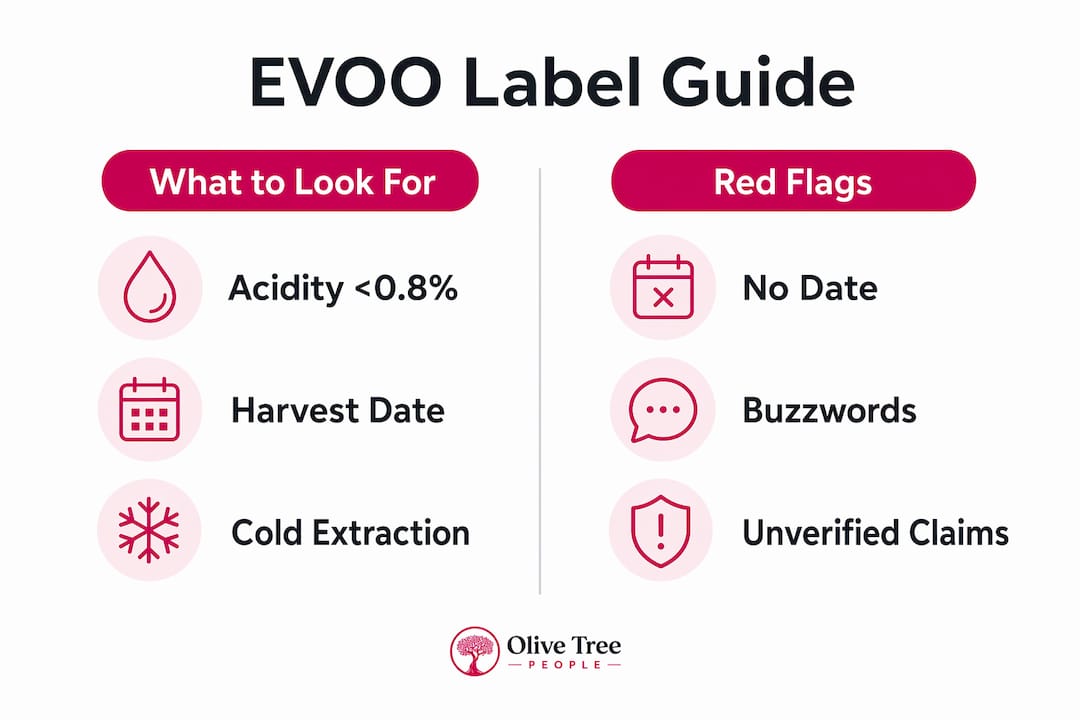
| Label element | What to look for | Red flag |
|---|---|---|
| Acidity percentage | Below 0.8%; ideally below 0.3% | No acidity figure listed |
| Harvest date | Month and year of harvest | Best-before date only |
| Origin | Named region or estate | “Mediterranean blend” or similar |
| Cultivar | Named variety, e.g. Coratina, Koroneiki | No variety mentioned |
| Certification | PDO, PGI, NAOOA, or COOC seal | Unverified “premium” or “artisanal” claims |
| Packaging | Dark tinted glass bottle | Clear glass or plastic |
Marketing buzzwords like “premium” or “artisanal” carry no regulated meaning. Any producer can print them. They often mask the absence of real quality data.
How do you identify authentic EVOO by smell and taste?
Sensory evaluation is the industry gold standard for identifying quality olive oil. Professional panels use it to certify EVOO, and you can apply the same basic technique at home. The sensory profile of authentic EVOO includes three mandatory positive attributes: fruitiness, bitterness, and pungency. An oil lacking any of these is not genuine EVOO.
Follow these steps to evaluate any oil you are considering:
- Pour a small amount into a glass. Use a narrow glass if possible, such as a wine glass or shot glass. About one tablespoon is enough.
- Warm the oil in your palms. Cup the glass and rotate it gently. Body heat releases the volatile aromatic compounds. Experienced tasters warm oil this way to unlock the full aroma before smelling.
- Smell the oil deeply. Fresh EVOO smells of green olives, freshly cut grass, tomato leaf, artichoke, or herbs. A flat, greasy, or waxy smell indicates degradation. A rancid or musty odour is a defect called “fusty” or “rancid” in professional tasting terminology.
- Take a small sip and draw air across it. This technique, called “strippaggio” in Italian tasting circles, spreads the oil across your palate. You are looking for bitterness on the mid-palate and a peppery finish at the back of the throat.
- Note the peppery finish. A genuine cough or throat prickle confirms high polyphenol content. EVOO’s pungency reflects polyphenol levels directly linked to its antioxidant health benefits. One cough suggests moderate polyphenols; two or three coughs indicate a high-polyphenol oil.
- Check for defects. Metallic, cooked, or vinegary notes all indicate faults. Any single defect disqualifies an oil from genuine EVOO classification under international standards.
Pro Tip: Attend a guided olive oil tasting event if you can. Comparing several oils side by side accelerates your ability to recognise authentic characteristics far faster than tasting in isolation. Terracenturia’s olive oil tasting checklist is a practical starting point for structuring your own sessions at home.
High-polyphenol oils from varieties like Coratina or Buga (a Slovenian Istrian cultivar) tend to be more intensely bitter and peppery than milder varieties. That intensity is a feature, not a flaw. It signals Mediterranean flavour complexity and functional quality.
Simple at-home tests for checking EVOO authenticity
Label checks and sensory tests are the most reliable methods, but a few simple observations at home add useful supporting evidence. None of these tests is definitive on its own. Use them alongside label scrutiny, not instead of it.
The cold test
Place the oil in the refrigerator for several hours. Real EVOO becomes cloudy and partially solidifies with needle-like crystals forming in the liquid. This happens because of its high monounsaturated fat content, primarily oleic acid, which solidifies at low temperatures. An oil that stays completely liquid may contain refined or seed oil additions. An oil that solidifies into a completely solid block may also indicate adulteration with saturated fats. The result should be partial cloudiness with visible crystals.
Visual and viscosity checks
Colour in EVOO ranges from pale golden to deep green depending on the cultivar and harvest time. Colour alone is not a reliable indicator of quality or authenticity. Do not assume a deep green oil is superior to a golden one. Viscosity is more telling. Genuine EVOO moves slowly and coats the glass when swirled. A very thin, fast-moving oil that behaves more like water suggests dilution or refinement.
The heating test
Heat a small amount of EVOO in a pan. Genuine EVOO has a smoke point of roughly 190–210 degrees Celsius, which is higher than many people assume. It should not smoke immediately at medium heat. An oil that smokes at low temperature or produces an unpleasant chemical smell when heated is likely refined or adulterated.
The table below compares what to expect from genuine versus fake EVOO across these tests.
| Test | Genuine EVOO | Fake or adulterated oil |
|---|---|---|
| Cold test | Cloudy, partial solidification with crystals | Fully liquid or completely solid |
| Colour | Variable: golden to deep green | Unnaturally uniform bright yellow |
| Viscosity | Slow, coats glass when swirled | Thin and watery |
| Heating | Smokes at 190°C or above | Smokes at low heat or smells chemical |
| Aroma when heated | Mild olive scent | Neutral, chemical, or rancid smell |
What red flags should you watch for when buying extra virgin olive oil?
Several common practices in the olive oil trade are designed to mislead buyers. Knowing them protects your money and your health.
- “Cold-pressed” as a selling point. Cold mechanical extraction is mandatory for all EVOO by law. A bottle advertising “cold-pressed” is simply meeting the legal minimum, not exceeding it. Cold-pressed is not a quality marker beyond the basic EVOO requirement.
- Vague origin labelling. Terms like “product of the EU” or “Mediterranean blend” mean the oil could come from multiple countries and multiple harvests blended together. Genuine quality oils name a specific region, estate, or country of single origin.
- No harvest date. An oil without a harvest date could be two or three years old. Polyphenols degrade significantly within 12–18 months of harvest. Old oil loses both flavour and health value.
- Clear glass or plastic packaging. Light degrades olive oil rapidly. Good packaging uses tinted glass to block light. Clear bottles on a brightly lit supermarket shelf are a direct warning sign.
- Unusually low price. Genuine EVOO from a single estate, harvested early, and cold-extracted costs more to produce than blended commercial oil. A price that seems too good to be true almost always reflects a quality compromise.
- “Pure” or “light” olive oil labels. These terms describe refined olive oil, not extra virgin. They are legal product categories but are not EVOO. Refined oils have been chemically or heat-treated to remove defects and most of their polyphenols.
Pro Tip: Buy from producers who publish their lab test results for free acidity, peroxide values, and polyphenol content. This level of transparency is rare but is the clearest possible signal of genuine quality.
Key takeaways
Identifying authentic EVOO requires combining label scrutiny, sensory evaluation, and simple physical tests, with no single method sufficient on its own.
| Point | Details |
|---|---|
| Acidity is the baseline standard | Genuine EVOO must show free acidity below 0.8%; premium oils fall below 0.3%. |
| Labels reveal producer intent | Harvest date, named cultivar, and specific origin separate transparent producers from vague ones. |
| Sensory tests are the gold standard | Fruity aroma, bitterness, and a peppery throat finish confirm authentic EVOO. |
| At-home tests add supporting evidence | The cold test and viscosity check supplement label and sensory checks but do not replace them. |
| Red flags are consistent | No harvest date, clear packaging, vague origin, and very low price all point to lower-quality oil. |
Why I trust sensory testing above everything else
I have tasted a lot of olive oil over the years, and the single most useful skill I have developed is learning to trust my palate over a label. Labels can be manipulated. Sensory characteristics cannot be faked once you know what you are looking for.
The peppery finish is the detail most people miss. When I first encountered a genuinely high-polyphenol oil, the throat prickle felt like a mistake. I thought something was wrong with the oil. The opposite is true. That sensation is the clearest sign that the oil is doing exactly what good EVOO should do. Oils without it are pleasant enough, but they are not delivering the functional benefits that make EVOO worth the premium.
My honest advice is to start with the label and use it to filter out obvious non-starters. No harvest date, no acidity figure, vague origin? Put it back. Then apply the sensory test to what remains. Over time, your ability to detect fruitiness, bitterness, and pungency becomes almost automatic. You stop needing to think through a checklist.
The rarity of truly premium EVOO is also worth acknowledging. Most oil on supermarket shelves, even bottles labelled extra virgin, does not meet the sensory standards that professionals apply. That is not cynicism. It is the reality of a market where blending and mislabelling are widespread. Finding an oil that genuinely passes every test is worth paying for. Terracenturia’s approach to high-polyphenol EVOO reflects exactly the kind of producer transparency I look for: named origin, published quality data, and a sensory profile that holds up.
— Mak
Terracenturia’s high-polyphenol EVOO: quality you can verify
Terracenturia produces organic EVOO from Slovenian Istria, a region with centuries of olive cultivation history. Every bottle carries the harvest date, acidity data, and cultivar information that this guide identifies as markers of genuine quality. The oils are cold-extracted and certified organic, with polyphenol levels that produce the peppery finish and bitter complexity described in the sensory tests above. The 500ml high-polyphenol EVOO suits regular kitchen use, while the 250ml HEALTH + EVOO is a practical option for those starting out with premium oil. Both meet every label and sensory criterion covered in this article.
FAQ
What is the legal acidity limit for extra virgin olive oil?
Authentic EVOO must have free acidity below 0.8%. Premium-quality oils typically fall below 0.3%, which indicates careful harvesting and rapid processing.
Does the cold test reliably prove EVOO is genuine?
The cold test is a useful indicator but not conclusive on its own. Genuine EVOO becomes cloudy and partially solidifies with crystals, but the test should always be combined with label checks and sensory evaluation.
What does “cold-pressed” mean on an olive oil label?
Cold mechanical extraction is a legal requirement for all EVOO, not a premium feature. The term “cold-pressed” confirms only that the oil meets the basic legal standard, not that it exceeds it.
How do I know if an olive oil has gone rancid?
Rancid oil smells waxy, greasy, or like old crayons. It lacks any fresh fruity or grassy aroma. Rancidity is a sensory defect that disqualifies an oil from genuine EVOO classification.
Which certifications confirm authentic EVOO quality?
The NAOOA, COOC, and European PDO and PGI seals all indicate independent third-party verification. The NAOOA tests products directly from retail shelves to confirm that label claims are accurate.