TL;DR:
- Manual hand-picking produces the highest-quality olive oil because it causes minimal fruit bruising and preserves polyphenols. Chemical-assisted harvesting presents environmental risks and degrades oil quality, so most quality-focused growers avoid it. Proper timing at veraison maximizes yield and antioxidant content, while thorough canopy inspection minimizes crop loss.
Olive harvesting methods are defined as the techniques used to detach and collect ripe olives from the tree, and the method chosen directly determines oil quality, yield, and long-term tree health. The two primary categories are manual harvesting and mechanical harvesting, each with distinct trade-offs for small growers and large-scale producers alike. Handpicked olives tend to produce superior oil because less fruit damage occurs during collection, preserving antioxidant levels and flavour. Mechanical methods increase efficiency on larger plots but require careful application to avoid stressing trees. Understanding which approach suits your orchard is the foundation of any sound olive cultivation strategy.
What are the primary olive harvesting methods explained?
Olive picking techniques fall into three broad categories: manual hand-picking, mechanical harvesting, and chemical-assisted harvesting. Each suits a different scale of operation and carries different implications for fruit quality and environmental impact.
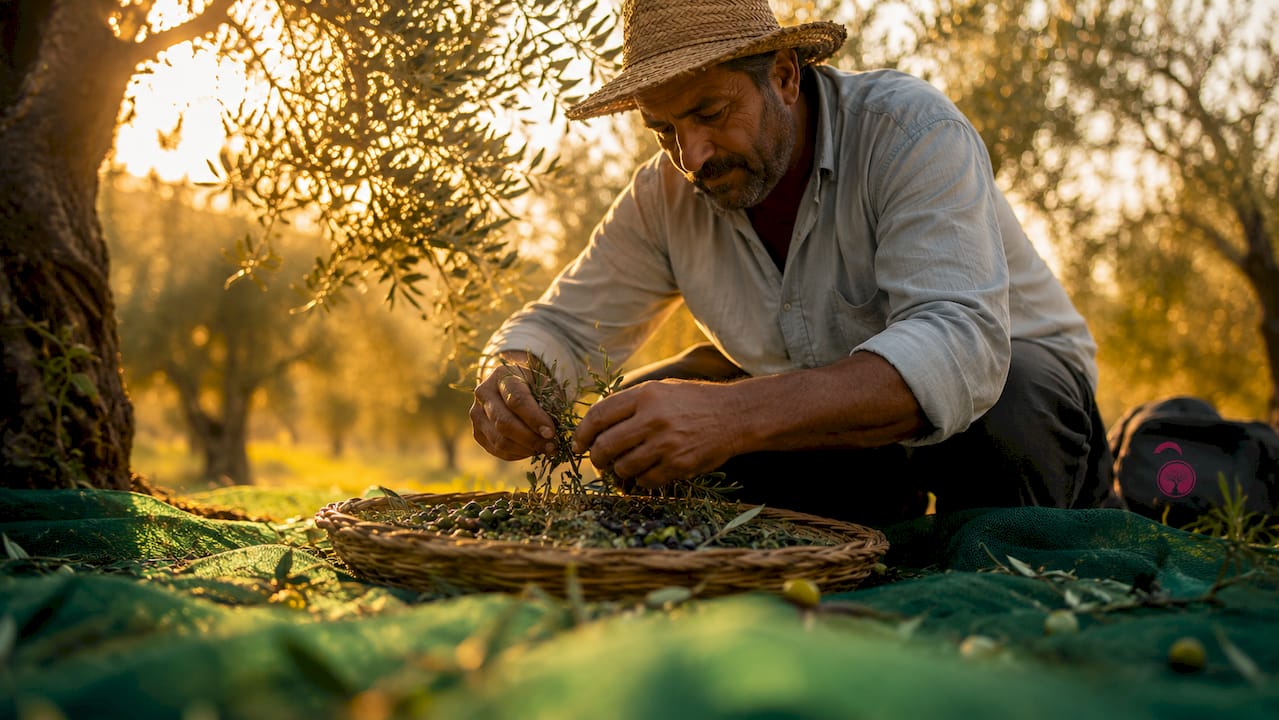
Manual harvesting is the oldest and most quality-focused approach. Farmers pick olives by hand or use small raking tools to comb fruit from branches directly onto nets spread beneath the tree. Ladders, step stools, nets, and plastic crates are standard equipment. Dry weather days are preferred so olives remain fresh for same-day pressing. Manual harvesting typically takes 2–3 hours per moderately sized tree. That time investment is significant, but the gentle handling keeps fruit intact and polyphenol content high.
Mechanical harvesting uses vibration-based machines, including trunk shakers and handheld electric rakes, to dislodge olives onto collection nets. This method reduces labour time considerably on large farms. Vibration harvesters require careful use, however, because excessive vibration can stress the tree and reduce long-term productivity.
Chemical-assisted harvesting applies ethylene-releasing compounds to accelerate fruit loosening before mechanical collection. It is lower cost initially, but chemical methods risk premature ripening, quality degradation, and harmful residues in the soil. Most quality-focused growers avoid this route.
- Manual hand-picking: highest quality, most labour-intensive
- Raking and combing: faster than pure hand-picking, still gentle on fruit
- Electric vibration rakes: good balance of speed and fruit integrity
- Trunk shakers: suited to large, established orchards with wide spacing
- Chemical-assisted loosening: lowest labour cost, highest environmental risk
Pro Tip: Lay nets generously beyond the canopy edge. Olives fall at an angle when shaken, and a narrow net loses fruit to the ground, where soil contact accelerates oxidation.
How do harvesting methods affect olive oil quality and sustainability?
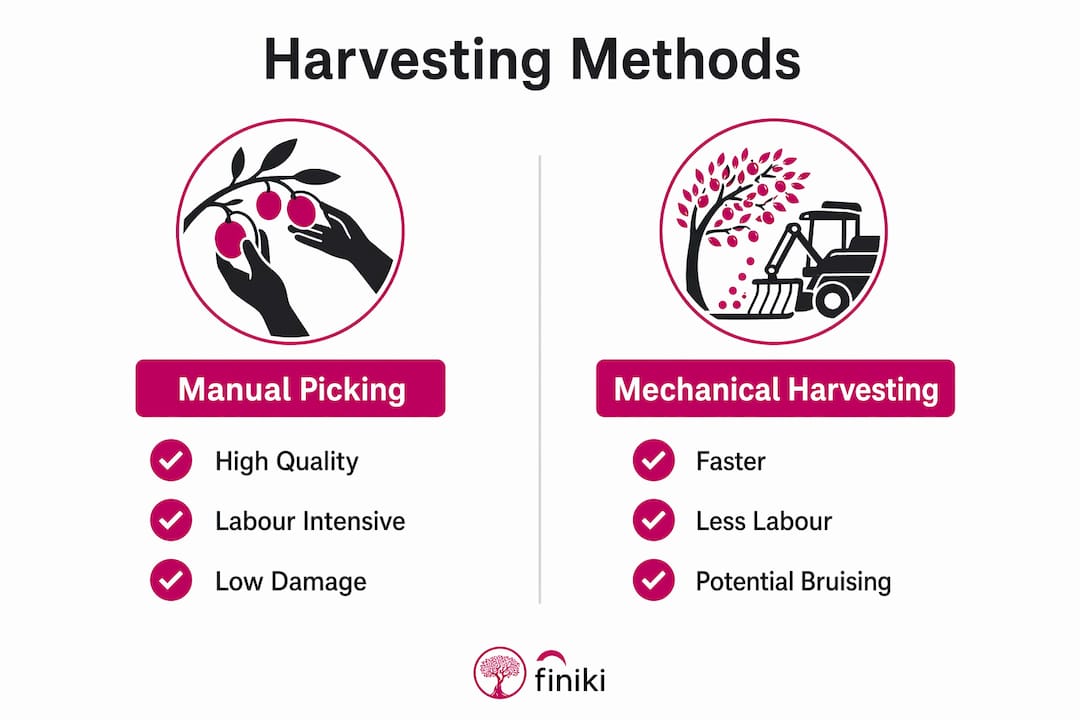
The harvesting method is the single biggest variable a grower controls after the growing season ends. It shapes oil flavour, antioxidant content, shelf life, and the health of the orchard for future seasons.
Quality impact of manual versus mechanical picking
Handpicked olives produce superior oil because bruising is minimal. Bruised fruit begins oxidising immediately, which lowers polyphenol levels and shortens shelf life. Mechanical vibration causes some bruising, but far less than chemical methods. The quality difference shows up most clearly in extra virgin olive oil (EVOO), where acidity thresholds and polyphenol counts are tightly regulated.
Environmental considerations
Vibration harvesting is favoured for ecological sustainability over chemical-assisted methods. Both can yield similar quantities, but vibration causes significantly less environmental damage. Chemical compounds used to loosen fruit can leach into soil, disrupt beneficial soil organisms, and leave residues that affect subsequent pressings. Growers committed to organic certification have no viable path through chemical-assisted harvesting.
| Method | Oil quality | Environmental impact | Labour demand |
|---|---|---|---|
| Manual hand-picking | Highest | Minimal | Very high |
| Vibration raking | High | Low | Moderate |
| Trunk shaker | Moderate | Low to moderate | Low |
| Chemical-assisted | Lower | High risk | Low |
Key sustainability considerations for any harvesting approach:
- Avoid harvesting in wet conditions, which increases soil compaction from foot traffic and machinery
- Rotate harvesting equipment across plots to reduce repeated mechanical stress on individual trees
- Compost leaf and twig waste from nets rather than burning it
- Press olives on the day of harvest wherever possible to prevent fermentation
What equipment and timing optimise olive harvesting efficiency?
The right tools and the right moment in the season determine whether a harvest is profitable or merely exhausting. Timing is as critical as technique.
When to harvest olives
The optimal harvest window is when olives shift from green to a purple-black colour, known as the veraison stage. At this point, polyphenol content is high and oil yield per kilogram of fruit is near its peak. Waiting too long causes olives to over-ripen, which raises acidity and reduces antioxidant levels. A single tree yields around 12 kg when young and 25–30 kg when mature. That yield difference matters when planning labour and logistics.
Step-by-step harvesting workflow
- Inspect the canopy before starting. Walk around each tree and identify clusters in the upper and inner branches. These are the areas most commonly missed.
- Spread nets beneath and beyond the full canopy spread. Overlap nets at the edges to prevent gaps.
- Begin at the top of the tree and work downward. Gravity pulls loosened olives onto already-covered ground.
- Use raking tools or vibration rakes on outer branches, then switch to hand-picking for inner clusters where machinery cannot reach cleanly.
- Gather and sort olives from the net promptly. Remove leaves, twigs, and damaged fruit before loading into crates.
- Transport to the mill the same day. Delay between harvest and pressing is the most common cause of quality loss.
Pro Tip: Despite thorough picking, 5–10% of olives can remain inside the canopy. Change your viewing angle after each pass and, where safe, climb into the tree to inspect inner branches from above.
Common challenges and solutions
Uneven terrain is the most frequent practical obstacle in traditional Mediterranean and Slovenian terraced orchards. Ladders on sloped ground require a second person for safety. Lightweight aluminium tripod ladders with adjustable legs solve this on most gradients. Crate management is another bottleneck: full crates left in direct sun for more than an hour begin warming the fruit. Keep crates in shade and move them to a cool vehicle promptly.
How do farmers balance labour costs, yield, and quality?
Choosing a harvesting method is ultimately an economic decision as much as an agronomic one. The right balance depends on farm size, market positioning, and access to processing facilities.
Labour intensity and cost trade-offs
Manual harvesting on small terraced plots, particularly in regions like Slovenian Istria, is labour-intensive and costly. It limits price competitiveness against super-intensive mass production operations that use fully mechanised harvesting on high-density plantings. Small producers survive and thrive by competing on quality, traceability, and direct producer-to-consumer relationships rather than volume. That is not a consolation prize. It is a deliberate market position that commands premium prices.
Processing thresholds and post-harvest logistics
Most local mills require a minimum pressing quantity of around 50 kg. Small growers who cannot reach that threshold must exchange oil by weight rather than receive oil pressed solely from their own fruit. This affects how growers plan their harvest: pooling fruit from multiple small plots or coordinating with neighbouring growers to meet minimums. Roughly 10 kg of olives converts to 1 litre of oil, so a grower with 200 kg of fruit can expect approximately 20 litres of oil. Planning around that ratio prevents logistical surprises at the mill.
| Farm scale | Recommended method | Key advantage | Main constraint |
|---|---|---|---|
| Small (under 50 trees) | Manual hand-picking | Highest oil quality | High labour cost |
| Medium (50–200 trees) | Manual with vibration rakes | Quality with efficiency | Equipment investment |
| Large (200+ trees) | Trunk shakers with nets | Low labour per kg | Tree stress risk |
Slovenian olive farming faces an additional structural challenge: dispersed plots and high costs have prompted calls for state support in land consolidation to improve harvesting efficiency. Until consolidation occurs, small producers benefit most from investing in quality rather than scale.
Key takeaways
The harvesting method a grower selects determines oil quality, environmental impact, and farm profitability more than almost any other post-season decision.
| Point | Details |
|---|---|
| Manual picking preserves quality | Hand-picking causes minimal bruising, keeping polyphenol levels and flavour at their peak. |
| Vibration beats chemicals | Vibration-based mechanical harvesting matches chemical yields with far less environmental damage. |
| Timing is critical | Harvest at veraison, when olives shift colour, to maximise oil yield and antioxidant content. |
| Canopy inspection prevents loss | Up to 10% of fruit stays hidden in the inner canopy; change angle and climb in to recover it. |
| Small growers compete on quality | Traceability and direct sales relationships outperform volume strategies for small-scale producers. |
What I have learned from watching growers get harvesting wrong
The most common mistake I see is treating the harvest as a single pass. A grower walks around the tree, rakes the outer branches, gathers the net, and moves on. That approach routinely leaves a tenth of the crop behind. The olives that stay on the tree either fall to the ground and oxidise, or they over-ripen and contaminate the next pressing if they are collected late. Neither outcome is acceptable when you are producing oil at a premium price point.
The second mistake is delaying the press. I have spoken with growers who harvest on a friday and press on a monday because the mill is closed over the weekend. Three days in a warm crate destroys much of what careful picking preserved. If your mill schedule does not align with your harvest window, find a different mill or adjust your harvest days. Quality is built or lost in those hours between tree and press.
What I find genuinely encouraging is that the artisanal methods that small Mediterranean and Slovenian producers use are not relics. They are competitive advantages. A traceable, handpicked, same-day-pressed oil from a named grove commands a price that no super-intensive operation can undercut on quality grounds. The growers who understand this stop apologising for their labour costs and start marketing their process as the product.
Technology has a role, but it is a supporting one. Electric vibration rakes have made small-scale harvesting faster without sacrificing fruit integrity. That is the right kind of mechanical adoption: targeted, gentle, and quality-preserving. Trunk shakers on a 50-tree terraced plot are the wrong tool entirely.
— Mak
Terracenturia and the craft behind every harvest
Terracenturia produces high-polyphenol organic EVOO from Slovenian Istria, where every bottle begins with the harvesting decisions described in this guide. The olives are hand-selected at peak veraison, pressed the same day, and tested for polyphenol content to verify quality at the source. That process is why Terracenturia’s oil reaches 1,371 mg/kg in polyphenols, a figure that reflects harvesting discipline as much as terroir. Farmers and enthusiasts who want to understand how the organic selection process connects harvesting to the final bottle will find detailed guidance across the Terracenturia site. The quality starts in the grove, and it shows in the oil.
FAQ
What is the best method for harvesting olives?
Manual hand-picking produces the highest-quality oil because it causes minimal bruising and preserves polyphenol levels. For larger operations, vibration-based mechanical harvesting offers a good balance of efficiency and fruit integrity.
When is the right time to harvest olives?
Harvest olives at veraison, when fruit transitions from green to purple-black. At this stage, oil yield per kilogram is near its peak and polyphenol content remains high.
How long does it take to harvest a single olive tree manually?
Manual harvesting takes approximately 2–3 hours per moderately sized tree using standard equipment including nets, ladders, and plastic crates.
Why is chemical-assisted harvesting discouraged for quality oil production?
Chemical-assisted harvesting risks premature ripening, flavour degradation, and soil contamination. It is incompatible with organic certification and reduces the antioxidant quality of the resulting oil.
How much oil does a mature olive tree produce?
A mature olive tree yields approximately 25–30 kg of fruit, and roughly 10 kg of olives converts to 1 litre of oil, giving an expected yield of around 2.5–3 litres per mature tree per season.