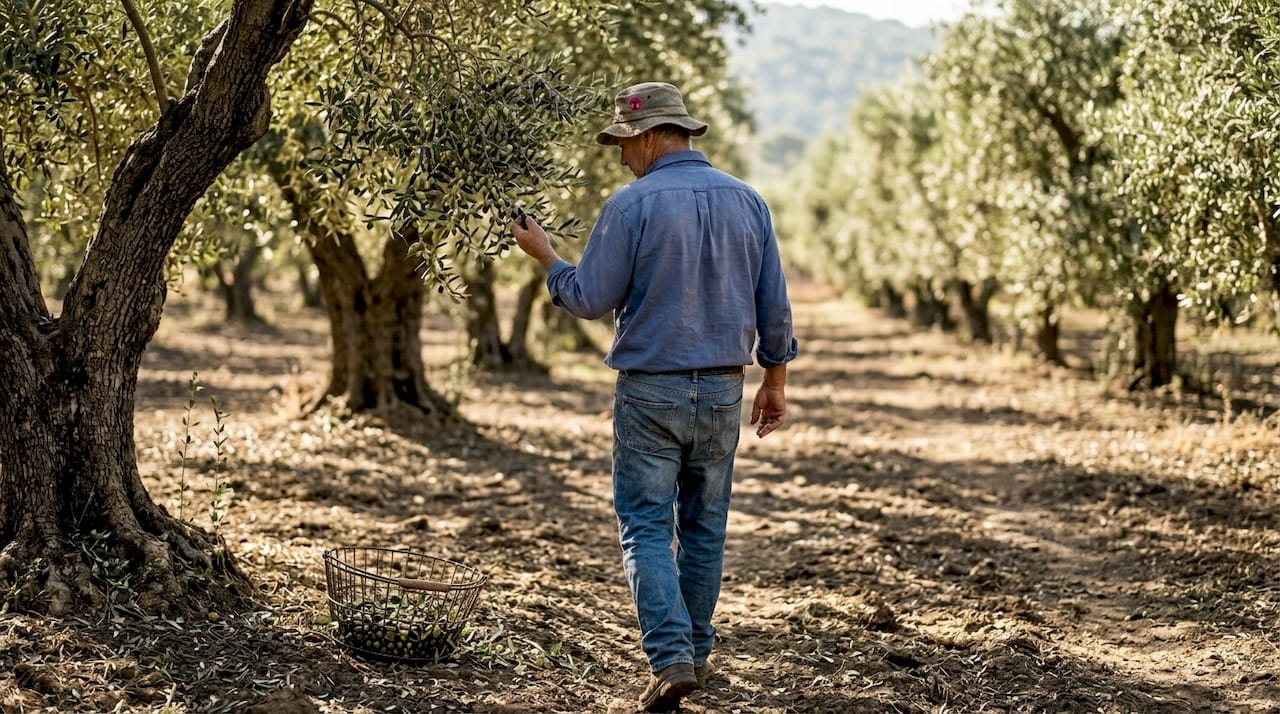
The word “organic” on an olive oil bottle feels reassuring. But here’s the reality most shoppers miss: that label alone means nothing without a certified, inspected, and documented process behind it. Organic certification is a rigorous system of standards, third-party audits, and ongoing renewals that separates genuinely chemical-free oils from clever marketing. If you care about what goes into your body and on your plate, understanding how organic olive oil earns its certification is the single most useful thing you can know before buying.
Table of Contents
- What makes olive oil organic?
- Step-by-step: How is organic olive oil certified?
- USDA vs. EU organic certification: Key similarities and differences
- How to recognize genuine organic olive oil in stores
- Health and taste: Why organic certification matters
- Experience the benefits of certified organic olive oil
- Frequently asked questions
Key Takeaways
| Point | Details |
|---|---|
| Strict certification standards | Certified organic olive oil is held to rigorous global standards, including third-party audits and annual renewals. |
| Beyond marketing labels | Look for official seals, not just claims, to ensure your olive oil is genuinely organic. |
| Health and flavor advantages | Certified organic oils may offer cleaner taste and higher polyphenols that support overall wellness. |
| Know your certifier | Trustworthy products provide traceability information and certifier details on every bottle. |
What makes olive oil organic?
Organic olive oil starts in the grove, not the bottle. At its core, “organic” means the olives were grown without synthetic pesticides, herbicides, or chemical fertilizers. But the standards for organic olive oil go further than just skipping chemicals. They require documented farming practices, soil health management, and a fully traceable supply chain from tree to table.
Both the U.S. and the EU have legally protected organic labels, but their frameworks differ in scope. The USDA National Organic Program (NOP) governs American-market oils, while EU Regulation 2018/848 sets the standard for European producers, requiring 95% organic ingredients, chemical and sensory testing, and full traceability across the production chain. Both systems share one non-negotiable: independent, third-party verification.
Here’s what organic certification actually guarantees:
- No synthetic pesticides or herbicides used in the grove
- No chemical fertilizers applied to the soil
- Documented farming records available for inspection
- Regular testing for chemical residues in the oil
- A certified, accredited body has reviewed and approved the producer
“Organic certification provides assurance of chemical-free production and sustainability, giving consumers confidence that what’s on the label reflects what’s in the bottle.”
For health-conscious buyers and gourmet enthusiasts, this matters on two levels. First, it’s a food safety guarantee. Second, it signals a producer who takes quality seriously enough to submit to external scrutiny. The organic olive oil benefits extend beyond the absence of chemicals. They reflect a philosophy of careful, intentional production.
Step-by-step: How is organic olive oil certified?
Certification isn’t a one-time stamp. It’s a structured process that producers must earn and maintain every single year. Here’s how it works in practice:
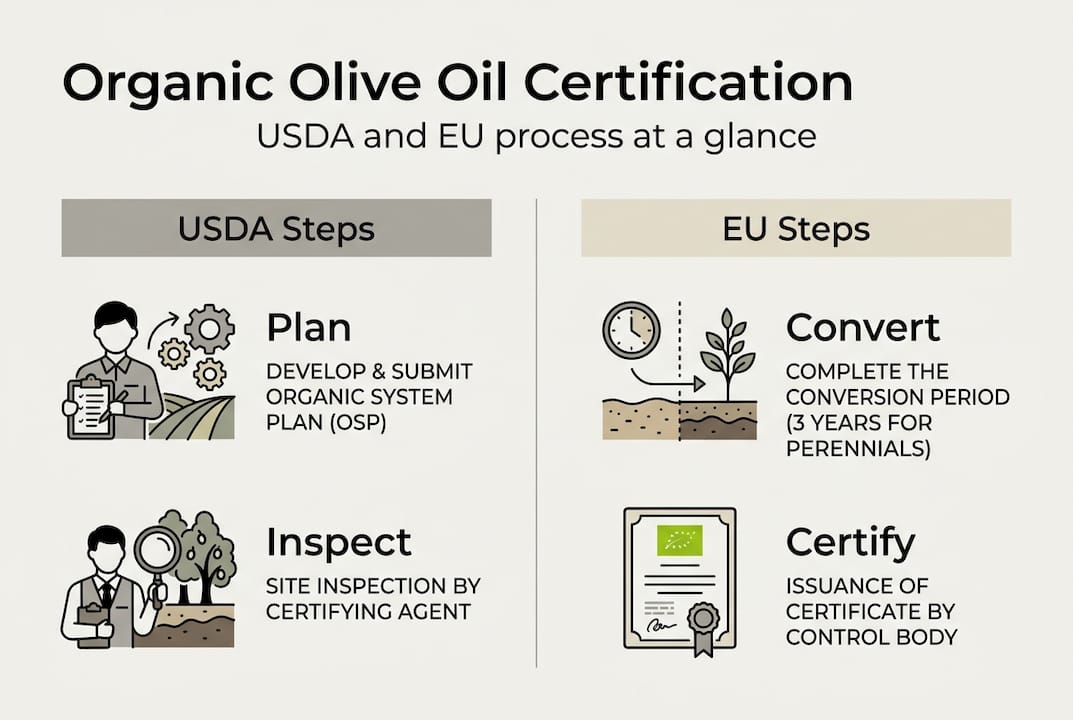
- Application and documentation. The producer submits a detailed Organic System Plan (in the U.S.) or equivalent documentation (in the EU), outlining every farming input, practice, and process used in the grove and mill.
- Review by a certifying agency. An accredited certifying body reviews the submitted records for compliance with organic standards before any inspection takes place.
- On-site inspection. A trained inspector visits the grove and the processing facility, checks physical records, interviews staff, and collects samples for laboratory testing.
- Certification decision. If the producer meets all requirements, certification is granted. If gaps are found, the producer must correct them before approval.
- Annual renewal. Certification is not permanent. Producers undergo annual audits and inspections to maintain their status.
The certification process from application to approval typically takes 3 to 6 months in the U.S., with annual renewals required to keep the certification active.
The EU adds an extra layer: a mandatory 3-year conversion period. If a grove was previously farmed using conventional methods, EU Regulation 2018/848 requires the land to go through three full years of organic management before the oil can carry the EU organic label. This ensures the soil and trees are genuinely free of residual chemicals before certification is granted.

| Stage | U.S. (USDA NOP) | EU (Regulation 2018/848) |
|---|---|---|
| Application | Organic System Plan | Equivalent documentation |
| Conversion period | Not required for existing organic land | 3 years mandatory |
| Inspection | Annual on-site | Annual on-site |
| Certification timeline | 3 to 6 months | 3 to 6 months (post-conversion) |
| Renewal | Annual | Annual |
Stat callout: The initial certification timeline runs 3 to 6 months for new applicants, but EU producers converting from conventional farming wait up to 3 years before their first certified harvest.
Pro Tip: When buying olive oil, look for both the organic seal and the certifying agency’s name on the label. A seal without a named certifier is a red flag worth investigating.
For a closer look at how quality producers approach this, the olive oil selection process and the olive oil evaluation guide offer practical frameworks for understanding what separates good certification from great production.
USDA vs. EU organic certification: Key similarities and differences
Not all organic seals carry the same weight, and knowing the difference helps you shop smarter. Both the USDA and EU programs require third-party inspection and detailed documentation, but their specific requirements diverge in meaningful ways.
| Feature | USDA Organic | EU Organic |
|---|---|---|
| Governing regulation | National Organic Program (NOP) | EU Regulation 2018/848 |
| Minimum organic content | 95% | 95% |
| Conversion period | Varies (3 years for new land) | 3 years mandatory |
| Traceability requirement | Required | Mandatory, stricter |
| Market focus | U.S. domestic | EU and international |
| Seal appearance | USDA Organic green seal | EU organic leaf logo |
USDA certification follows the National Organic Program rules, while EU certification follows Regulation 2018/848. Both are credible, but the EU standard’s stricter traceability requirements and mandatory conversion period make it particularly rigorous for imported oils, including those from Mediterranean producers.
Here’s what to look for on the bottle:
- USDA Organic seal: Green and white circular logo, required for U.S.-certified oils
- EU organic leaf logo: Green leaf on a white or black background, required for EU-certified oils
- Certifying agency name: Always listed separately from the seal itself
- Country of origin: Required on both U.S. and EU certified products
Pro Tip: Premium oils often carry both an organic certification and a taste quality seal, such as those from the COOC (California Olive Oil Council) or the IOC (International Olive Council). These dual certifications signal a producer committed to both purity and flavor, not just paperwork compliance.
For a deeper comparison of how organic certification relates to oil grade, the EVOO vs organic oil guide breaks down the distinctions clearly.
How to recognize genuine organic olive oil in stores
Shopping for certified organic olive oil should be straightforward, but misleading labels make it harder than it needs to be. Here’s a practical checklist to use at the shelf:
- Look for an official seal. The USDA Organic seal or EU organic leaf logo must appear on the label. No seal means no certification.
- Find the certifying agency. A legitimate certified oil names the accredited body that issued the certification, such as Oregon Tilth or CCPB.
- Check the country of origin. Certified oils must disclose where the olives were grown, not just where the oil was bottled.
- Look for batch traceability. Lot numbers or batch codes allow you to trace the oil back to a specific harvest and producer.
- Find the harvest date. Fresh olive oil is better oil. A harvest date tells you how old the oil is, which matters for both flavor and polyphenol content.
Watch out for these common marketing tricks:
- “Natural” or “pure” labels with no certification seal
- “Made with organic olives” without a full organic certification
- Missing certifier name or vague “certified organic” claims with no supporting detail
- No country of origin or harvest date on the label
“Organic on the bottle should mean a certified, inspected, and fully traceable journey from grove to you. Anything less is just a marketing claim.”
Pairing organic certification with additional quality seals from the COOC or IOC gives you extra assurance that the oil meets both purity and sensory standards. To verify olive oil quality beyond the label, look for polyphenol content data and independent taste evaluations. The olive oil quality markers guide explains exactly what those numbers mean for your health.
Health and taste: Why organic certification matters
For health-conscious consumers, organic certification delivers something no marketing claim can: documented proof that the oil in your bottle was produced without synthetic chemicals. That peace of mind is real and measurable.
Organic production methods also create conditions that may support higher polyphenol levels in the finished oil. Polyphenols are the antioxidant compounds that give high-quality extra virgin olive oil its distinctive bitterness, peppery finish, and health-promoting properties. Stress-free, chemical-free growing environments allow olive trees to produce more of these protective compounds naturally.
“Organic olive oil’s appeal lies in its assurance of chemical-free, sustainable production, with the potential for higher polyphenol content that health-focused consumers and chefs actively seek.”
Here’s why certified organic EVOO earns its place in both the kitchen and a wellness routine:
- Food safety: No pesticide or herbicide residues in the oil you consume
- Flavor integrity: Chemical-free growing often produces more complex, nuanced flavor profiles
- Higher antioxidant potential: Organic production conditions may support elevated polyphenol levels
- Environmental stewardship: Certified organic farming protects soil health, water quality, and local ecosystems
- Traceability: You know exactly where your oil came from and how it was made
For gourmet enthusiasts, the flavor argument is just as compelling as the health case. High polyphenol organic EVOOs are prized by professional chefs for their intensity and complexity. A well-certified oil from a single-origin grove, like those produced in Slovenian Istria, carries the character of its specific terroir in every drop. That’s something no blended, uncertified oil can replicate.
Experience the benefits of certified organic olive oil
Understanding certification is the first step. Finding an oil that actually meets those standards is the next one. At Terra Centuria, every bottle starts with a commitment to rigorous organic certification, high polyphenol content, and full traceability from our groves in Slovenian Istria to your table.
We’ve built our olive oil selection process around the same standards described in this guide, so you never have to guess whether what’s on the label reflects what’s in the bottle. Our organic olive oil evaluation guide walks you through exactly what to look for in a premium certified EVOO, from polyphenol counts to sensory profiles. When you’re ready to put that knowledge to use, you can shop certified organic EVOO directly from our collection and experience the difference that genuine certification makes.
Frequently asked questions
What does it mean when olive oil is certified organic?
It means the oil has been third-party inspected for chemical-free production, meets strict regulatory standards, and carries a seal from an accredited certifying body, not just a marketing claim.
How long does organic olive oil certification take?
In the U.S., initial certification takes 3 to 6 months with annual renewal required. EU producers converting from conventional farming must complete a mandatory 3-year conversion period before their first certified harvest.
What is the difference between ‘organic’ and ‘extra virgin’ olive oil?
“Organic” describes how the olives were grown, while “extra virgin” refers to the oil’s quality and extraction method. An oil can be one, both, or neither, and the best oils are certified as both.
Do organic certifications improve olive oil’s health benefits?
Organic oils may carry higher polyphenol content and fewer chemical residues, which supports stronger antioxidant activity and greater purity compared to conventionally produced oils.
How can I be sure my olive oil is truly organic?
Check for a recognized certification seal, the certifying agency’s name, and a batch number on the bottle. These three elements together confirm the oil’s certified status and allow full traceability.