
Most people reach for olive oil without realizing they’re using one of humanity’s oldest crafts, dating back over 8,000 years to ancient civilizations. This precious liquid shaped economies, religious rituals, medicine, and cuisine across millennia. Understanding how olive oil production originated and evolved reveals not just agricultural history, but the story of human innovation, cultural exchange, and our enduring quest for health and flavor. You’ll discover how ancient crushing methods transformed into modern extraction techniques, why Mediterranean cultures revered this golden oil, and how today’s premium varieties continue a legacy of craftsmanship and wellness.
Table of Contents
- Key takeaways
- Ancient origins and early production methods
- Expansion and technological advancements in olive oil production
- Cultural significance and health benefits of olive oil through history
- Modern production trends and challenges in olive oil craftsmanship
- Explore premium organic olive oils at Terra Centuria
- FAQ
Key Takeaways
| Point | Details |
|---|---|
| Ancient origins | Olive oil production began around 6000 BC in the Levant and shaped economies, rituals, and cuisine across millennia. |
| Early extraction methods | Stone mills mortars and woven mats were used to crush olives and press paste to separate oil from water. |
| Cold press quality | The first cold pressing produced the finest oil while later hot pressings yielded more oil but lower quality. |
| Global spread | Mediterranean cultivation and production spread through Phoenicians Greeks and Romans to Europe the Americas and beyond. |
| Modern breakthroughs | Hydraulic presses arrived in 1833 and later centrifugal methods increased efficiency while preserving traditional craft. |
Ancient origins and early production methods
The story of olive oil begins in the fertile crescent of the Eastern Mediterranean. Archaeological evidence confirms that olive oil production originated around 6000 BC in the Levant region, encompassing modern-day Israel, Palestine, Syria, and Lebanon. Early communities recognized the olive tree’s remarkable gifts and developed ingenious techniques to extract its precious oil.
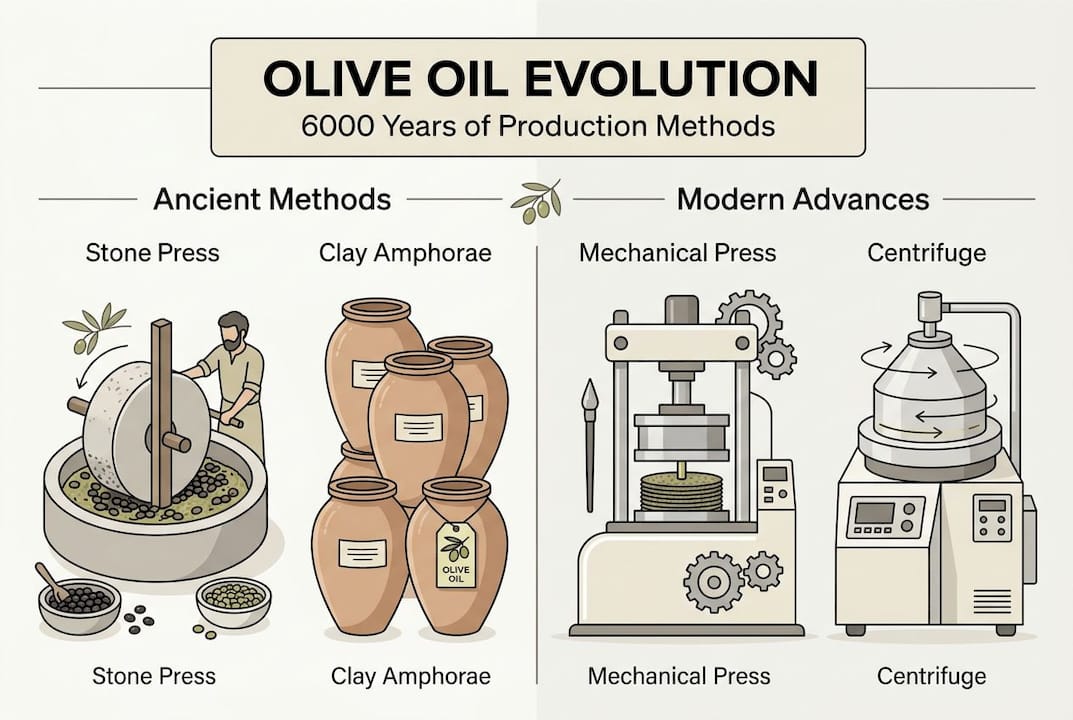
Initial production methods were labor-intensive yet effective. Workers crushed ripe olives using stone mills, mortars, and pestles to create a thick paste. This paste then underwent pressing, where early methods involved crushing with stone mills and pressing using woven mats stacked in layers. The pressing mechanisms evolved from simple lever-and-weight systems to more sophisticated beam presses and eventually screw presses.
The extraction process relied on a natural physical principle. Oil and water separate based on density differences, with oil floating to the surface where workers could skim it off. This decantation process required patience and skill, as multiple pressings yielded different quality grades. The first cold pressing produced the finest oil, prized for its flavor and purity, while subsequent hot pressings extracted more volume but lower quality.
These foundational techniques established patterns that would influence artisanal olive oil production methods for thousands of years. The basic principles of crushing, pressing, and separating remain relevant even as technology has dramatically improved efficiency and consistency.
Key elements of ancient production:
- Stone mills and mortars crushed whole olives into workable paste
- Woven fiber mats held the paste during pressing operations
- Lever, beam, and screw press mechanisms applied gradual pressure
- Natural density separation allowed oil collection without chemicals
- Multiple pressings extracted different quality grades from the same batch
Pro Tip: Understanding these ancient methods helps you appreciate why cold-pressed, first-extraction oils command premium prices today. The principles haven’t changed, only the efficiency and precision of modern equipment.
Expansion and technological advancements in olive oil production
As Mediterranean civilizations flourished, olive cultivation and oil production spread far beyond its Levantine birthplace. The Phoenicians, Greeks, and Romans became instrumental in disseminating olive growing knowledge throughout their trading networks and conquered territories. Remarkably, olives were cultivated in Italy over a thousand years before Rome’s rise to power, challenging previous assumptions about the timeline of European olive agriculture.
The geographic expansion accelerated during the Age of Exploration. Portuguese and Spanish colonizers introduced olive trees to the Americas in the 16th century, establishing groves in Mexico, Peru, and California. This transplantation created entirely new olive oil producing regions that would eventually rival Mediterranean output.
Technological innovation transformed production efficiency over centuries. The most significant breakthrough came when hydraulic presses were introduced in 1833 in Spain, applying consistent mechanical force far exceeding human-powered systems. This innovation dramatically increased extraction rates and reduced labor requirements. The mid-20th century brought another revolution with centrifugal extraction, enabling continuous processing rather than batch operations.
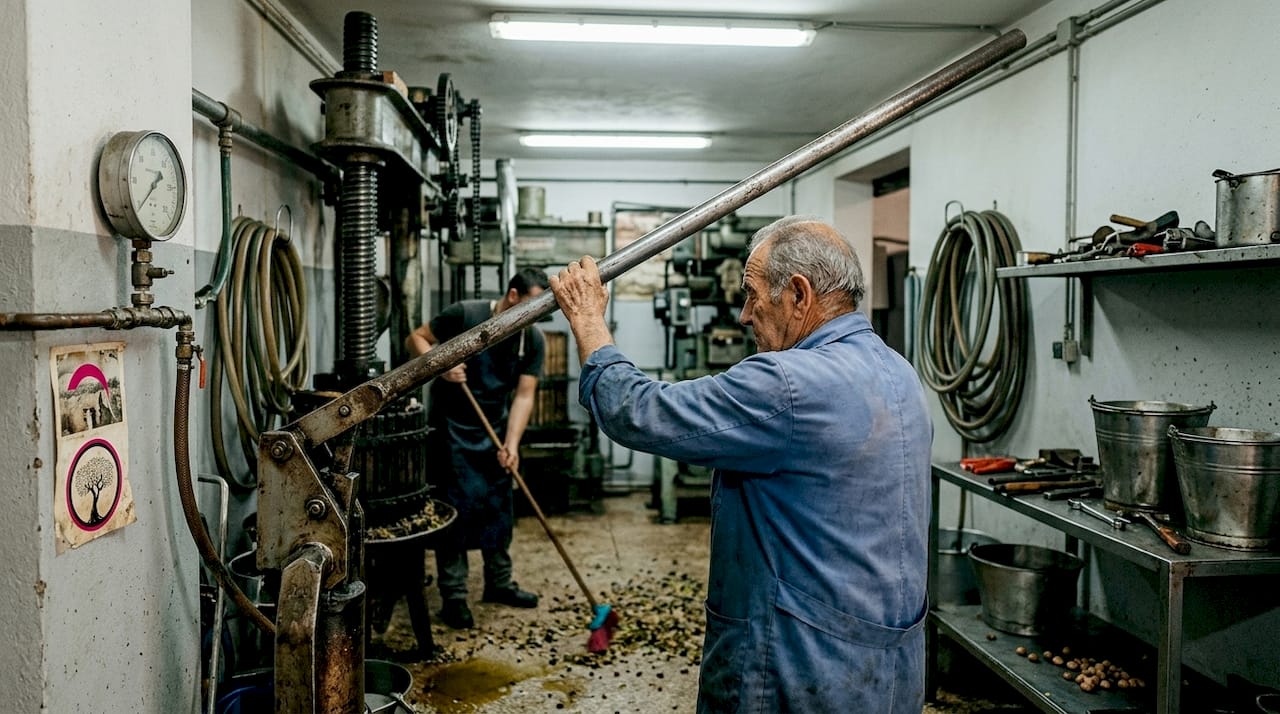
Modern production methods balance efficiency with quality preservation. While industrial facilities can process tons of olives hourly, premium producers often maintain traditional production methods or hybrid approaches that honor ancestral wisdom while incorporating technological precision.
Timeline of major production milestones:
- 6000 BC: First olive oil production in the Levant using stone tools
- 3000-1000 BC: Phoenician and Greek expansion across Mediterranean
- 1000 BC-500 AD: Roman cultivation throughout empire, Italian dominance
- 1500s AD: Introduction to Americas via Spanish and Portuguese explorers
- 1833 AD: Hydraulic press invention revolutionizes extraction efficiency
- 1950s-1970s AD: Centrifugal systems enable continuous industrial production
- 2000s-present: Focus on quality, sustainability, and polyphenol preservation
| Production Method | Time Period | Key Characteristics | Oil Quality |
|---|---|---|---|
| Manual Stone Crushing | 6000 BC – 1800s AD | Labor-intensive, small batches, inconsistent pressure | Variable, often oxidized |
| Hydraulic Pressing | 1833 – 1950s | Mechanical force, batch processing, improved consistency | Good, some heat exposure |
| Centrifugal Extraction | 1950s – present | Continuous flow, temperature control, high efficiency | Excellent when cold-processed |
| Modern Cold-Press | 1990s – present | Below 27°C, minimal oxidation, polyphenol preservation | Superior, maximum health compounds |
The evolution from ancient to modern techniques demonstrates humanity’s persistent drive to improve both efficiency and quality. Today’s best producers use temperature-controlled centrifuges that extract oil without the oxidation and heat damage that plagued earlier methods.
Cultural significance and health benefits of olive oil through history
Olive oil transcended its role as mere food to become a cornerstone of Mediterranean civilization. Ancient societies recognized its versatility, using it in rituals, cosmetics, and medicine while considering it a symbol of peace and prosperity. Greek athletes rubbed it on their bodies before competitions, believing it enhanced performance and protected skin. Romans used it for lighting lamps, preserving food, and treating wounds.
The olive branch became an enduring symbol of peace, appearing in religious texts, diplomatic ceremonies, and cultural traditions. Victorious Olympic athletes received olive wreaths, and anointing with oil marked sacred rituals across multiple faiths. This cultural reverence reflected olive oil’s genuine value in societies where it represented wealth, health, and divine favor.
Modern science has validated what ancient cultures understood intuitively. Today, olive oil anchors the Mediterranean diet, renowned for promoting longevity and reducing chronic disease risk. Research confirms that extra virgin olive oil contains heart-healthy compounds like polyphenols and monounsaturated fats that lower inflammation, improve cholesterol profiles, and protect against cardiovascular disease.
The health benefits stem from olive oil’s unique chemical composition. Polyphenols act as powerful antioxidants, neutralizing free radicals that damage cells and accelerate aging. Oleic acid, the primary monounsaturated fat, supports healthy blood vessel function and may reduce cancer risk. Unlike refined oils stripped of beneficial compounds, high polyphenol olive oil health benefits remain intact when proper production methods preserve these delicate molecules.
Quality matters enormously for health outcomes. Extra virgin olive oil benefits far exceed those of refined varieties because cold-pressing below 27°C preserves heat-sensitive polyphenols and vitamins. Industrial processing using high temperatures and chemical solvents destroys these compounds, leaving nutritionally inferior oil.
Historical and modern uses of olive oil:
- Religious ceremonies and ritual anointing across Mediterranean cultures
- Cosmetic applications for skin care, hair treatment, and massage
- Medicinal treatments for wounds, digestive issues, and inflammation
- Lighting fuel in lamps before petroleum-based alternatives
- Food preservation through submersion and protective coating
- Culinary foundation of Mediterranean cuisine and diet
- Modern wellness applications for cardiovascular and metabolic health
Pro Tip: Choosing cold-pressed, high-polyphenol extra virgin olive oil maximizes your antioxidant intake. Look for harvest dates within the past 18 months and storage in dark glass bottles to ensure freshness and potency.
The continuity between ancient reverence and modern scientific validation demonstrates olive oil’s genuine value. What Mediterranean ancestors knew through observation, contemporary research confirms through rigorous study. This convergence of tradition and science makes olive oil unique among foods.
Modern production trends and challenges in olive oil craftsmanship
The global olive oil industry has experienced remarkable volatility in recent years. Production reached approximately 3.57 million tonnes in the 2024/25 crop year, representing a dramatic 38% year-over-year increase. This surge followed several years of drought-impacted harvests, particularly in Spain, which produces nearly half the world’s olive oil.
Forecasts for 2025/26 predict a slight decline to 3.44 million tonnes as production normalizes. Spain, Italy, and Greece remain the dominant producers, though emerging regions in California, Australia, and South America continue expanding their market share. This geographic diversification helps stabilize supply chains vulnerable to regional climate disruptions.
Climate change poses the industry’s most significant long-term challenge. Rising temperatures, shifting rainfall patterns, and increased pest pressure threaten traditional growing regions. Sustainability challenges and premium EVOO demand are reshaping production priorities. Producers invest in drought-resistant cultivars, precision irrigation systems, and integrated pest management to maintain yields while reducing environmental impact.
Consumer demand has shifted dramatically toward premium extra virgin varieties. Health-conscious buyers seek oils with verified polyphenol content, organic certification, and transparent sourcing. This trend rewards producers who prioritize quality over quantity, often using premium high polyphenol EVOO benefits as a key marketing differentiator.
The tension between industrial efficiency and artisanal quality defines modern production. Large-scale operations achieve economies of scale but sometimes sacrifice the nuanced flavors and maximum polyphenol preservation that small-batch producers deliver. The market increasingly segments between commodity oils for cooking and premium oils for finishing and health applications.
| Production Metric | 2023/24 | 2024/25 | 2025/26 (Forecast) | Change |
|---|---|---|---|---|
| Global Production | 2.59M tonnes | 3.57M tonnes | 3.44M tonnes | +38% then -4% |
| Spain Output | 0.85M tonnes | 1.35M tonnes | 1.25M tonnes | Major recovery |
| Italy Output | 0.29M tonnes | 0.22M tonnes | 0.30M tonnes | Volatile weather impact |
| Greece Output | 0.25M tonnes | 0.30M tonnes | 0.28M tonnes | Steady contributor |
| Average Price (€/kg) | €8.50 | €6.20 | €6.80 (est.) | Stabilizing after spike |
Technology continues advancing extraction and quality control. Modern mills use real-time monitoring to maintain optimal temperatures, oxygen levels, and processing speeds. Some producers employ nitrogen flushing during bottling to prevent oxidation. Lab testing now routinely measures polyphenol content, allowing producers to verify health claims and justify premium pricing.
The industry faces an identity challenge as it scales. Mass production risks commoditizing a product whose value historically derived from regional character and artisanal care. Successful producers balance heritage craftsmanship with modern efficiency, maintaining quality standards while achieving viable production volumes.
Pro Tip: Supporting sustainable, high-polyphenol extra virgin olive oil helps ensure both quality and environmental responsibility. Look for producers who publish sustainability reports and third-party polyphenol testing to verify their claims.
The future of olive oil production depends on adapting ancient wisdom to contemporary challenges. Climate resilience, sustainable practices, and uncompromising quality standards will separate thriving producers from those who cannot meet evolving market demands.
Explore premium organic olive oils at Terra Centuria
After understanding olive oil’s rich history and profound health benefits, you might wonder where to find oils that honor this legacy. Terra Centuria specializes in high polyphenol organic EVOO produced in Slovenian Istria using methods that blend traditional craftsmanship with modern quality standards. Each bottle reflects the careful attention to harvest timing, cold-pressing, and storage that preserves maximum polyphenol content.
The organic olive oil selection process prioritizes oils from groves managed without synthetic pesticides or fertilizers, ensuring purity alongside potency. By choosing cold pressed olive oil antioxidants, you access the same health-promoting compounds that made olive oil precious to ancient civilizations, now verified through modern testing and delivered with unprecedented freshness.
FAQ
How did ancient methods of olive oil production influence modern techniques?
Ancient crushing and pressing principles remain fundamental to quality olive oil production today. While stone mills have been replaced by stainless steel crushers and hydraulic presses evolved into centrifuges, the core process of mechanically extracting oil without heat or chemicals continues. Modern cold-pressing maintains temperatures below 27°C, echoing ancient producers’ recognition that heat degrades flavor and nutrition.
Why is extra virgin olive oil considered healthier than other types?
Extra virgin olive oil undergoes cold-pressing without chemical refinement, preserving polyphenols, vitamins, and beneficial fats that refined oils lose during high-heat processing. These antioxidant compounds provide anti-inflammatory and cardiovascular benefits absent in chemically extracted or heat-processed oils. The extra virgin olive oil benefits stem directly from this minimal processing approach that maintains the oil’s natural chemical integrity.
How has olive oil production adapted to climate and sustainability challenges?
Producers increasingly invest in drought-resistant olive varieties, precision irrigation systems, and organic pest management to combat climate volatility. Many implement water recycling, solar power, and waste composting to reduce environmental impact. Sustainable agriculture practices protect soil health and biodiversity while ensuring olive groves can continue producing for future generations, preserving both heritage and ecosystem balance.
What makes high-polyphenol olive oil more valuable for health?
Polyphenols are powerful antioxidants that reduce inflammation, protect against oxidative stress, and support cardiovascular health. Oils with verified high polyphenol content deliver greater health benefits per serving, making them functionally superior despite higher prices. Early harvest timing, rapid processing, and proper storage maximize polyphenol preservation, explaining why premium producers emphasize these factors.
How can consumers identify authentic high-quality olive oil?
Look for harvest dates within 18 months, dark glass bottles that prevent light damage, and third-party certifications verifying extra virgin status. Reputable producers publish polyphenol test results and provide traceability to specific groves or regions. Authentic quality oil has a fresh, slightly bitter or peppery taste indicating polyphenol presence, unlike the bland, greasy character of refined or oxidized oils.