
TL;DR:
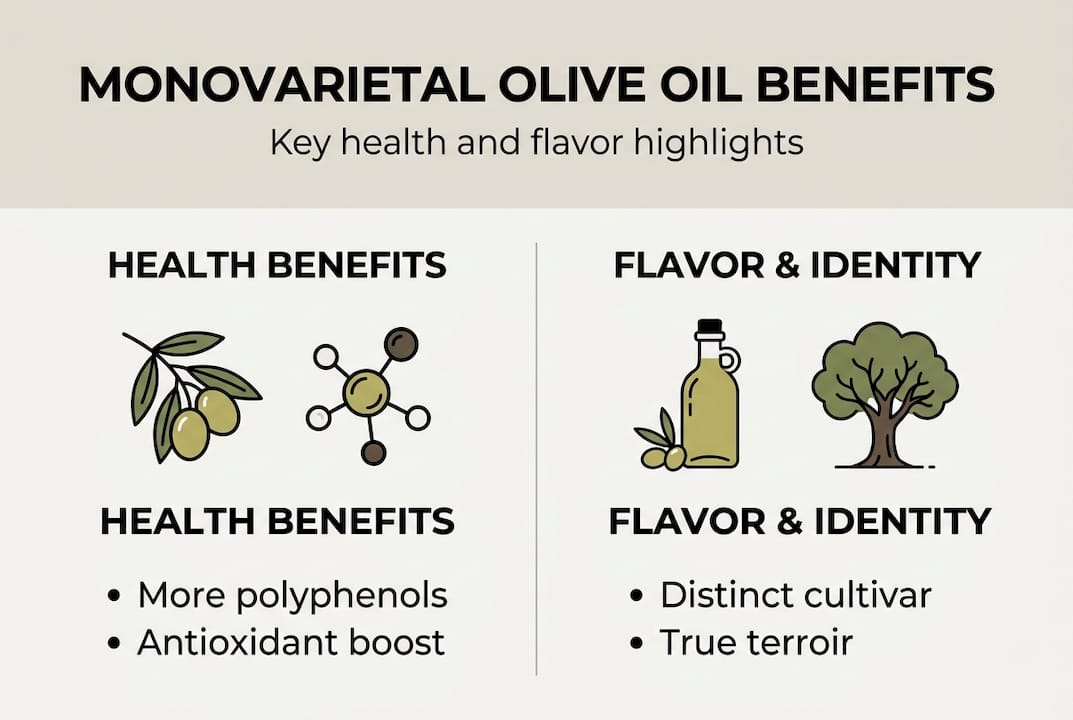
- Monovarietal olive oils are produced from a single olive cultivar, offering distinct flavors and higher polyphenol levels.
- They provide measurable health benefits, especially due to higher antioxidant compounds like oleocanthal.
- To choose quality monovarietal oils, look for cultivar, harvest date, and lab-verified polyphenol content on labels.
Most people assume olive oil is olive oil. You pick a bottle off the shelf, check that it says “extra virgin,” and move on. But that assumption quietly costs you real health benefits and genuine flavor. Monovarietal olive oil is a fundamentally different product, pressed from a single olive cultivar rather than a blend of many varieties. The difference shows up in polyphenol concentration, taste complexity, and the ability to trace every drop back to a specific grove and harvest. This article breaks down exactly what sets monovarietal oils apart, why the health data is compelling, and how to find one worth buying.
Table of Contents
- What is monovarietal olive oil?
- The health benefits of monovarietal olive oils
- Flavor, authenticity, and the gourmet experience
- How to select a high-quality monovarietal olive oil
- Why most people settle for blended olive oil and miss out
- Explore high-polyphenol monovarietal olive oils with Terra Centuria
- Frequently asked questions
Key Takeaways
| Point | Details |
|---|---|
| Unique health benefits | Monovarietal oils often provide up to 40% more polyphenols and stronger antioxidant effects. |
| Distinctive flavor profiles | Each cultivar delivers a specific taste, allowing gourmet experiences and targeted food pairings. |
| Proven authenticity | Traceability and origin verification ensure you get exactly what’s promised on the label. |
| Easy selection tips | Check for cultivar name, polyphenol content, and recent harvest date to choose the best oil. |
What is monovarietal olive oil?
The word “monovarietal” simply means one variety. Monovarietal olive oil is produced from a single olive cultivar, resulting in a unique flavor profile, chemical fingerprint, and often higher concentrations of beneficial polyphenols compared to blended oils. That single-cultivar origin is what makes it traceable, distinctive, and often more potent from a health standpoint.
Blended olive oils, by contrast, are made by combining multiple olive varieties, sometimes from different regions or even different countries. Blending is common because it produces a consistent, mild flavor that appeals to a broad market. It also allows producers to stretch higher-quality fruit with lower-quality olives without the consumer noticing. The result is a product optimized for shelf appeal rather than nutritional density.
With a monovarietal oil, you know exactly what you are getting:
- The cultivar name: Koroneiki, Coratina, Picual, Leccio del Corno, or any of hundreds of regional varieties
- The harvest region: Terroir matters in olive oil just as it does in wine
- The chemical profile: Each cultivar has a distinct ratio of oleic acid, polyphenols, and volatile aromatic compounds
- The harvest date: Freshness is directly tied to polyphenol content, and monovarietal labels typically include this
Polyphenol content is where the real gap between monovarietal and blended oils becomes measurable. High-polyphenol monovarietal cultivars can contain 20 to 40 percent more polyphenols than a typical commercial blend. For anyone using olive oil as a functional food rather than just a cooking fat, that difference is significant. You can explore what those numbers mean in practice in this high polyphenol olive oil guide.
The cultivar also shapes the oil’s sensory identity in ways a blend cannot replicate. A Koroneiki from the Peloponnese carries a grassy, peppery intensity. A Coratina from Puglia is famously bitter and robust. A Slovenian Istrian Istrska belica is herbaceous with a long, spicy finish. These are not subtle differences. They are the kind of distinctions that make monovarietal oils genuinely interesting to taste and evaluate, as covered in this olive oil evaluation guide.
In short, monovarietal olive oil is not a marketing term. It is a production standard that prioritizes identity, quality, and traceability over volume and consistency.
The health benefits of monovarietal olive oils
The health case for monovarietal olive oil starts with polyphenols. These are naturally occurring plant compounds that act as antioxidants and anti-inflammatory agents in the body. Higher polyphenol content in certain monovarietal cultivars provides superior health benefits, including antioxidant and anti-inflammatory effects, cardiovascular protection, and mitochondrial modulation. Not all olive oils deliver these benefits at the same level, and cultivar choice is one of the biggest variables.

Here is how some of the most studied cultivars compare in typical polyphenol concentration:
| Cultivar | Typical polyphenol range (mg/kg) | Key health compound |
|---|---|---|
| Coratina | 800 to 1,200 | Oleacein, oleocanthal |
| Koroneiki | 600 to 1,000 | Oleocanthal, oleuropein |
| Picual | 500 to 900 | Oleuropein, hydroxytyrosol |
| Leccio del Corno | 500 to 800 | Oleacein |
| Istrska belica | 600 to 1,100 | Oleocanthal, oleuropein |
These numbers vary with harvest timing, altitude, and processing, but the pattern is consistent: certain monovarietal cultivars reliably outperform generic blends.
Oleocanthal deserves special mention. It is the compound responsible for the throat-burning sensation you feel when you swallow a high-quality oil. That burn is not a defect. It signals the presence of a natural anti-inflammatory compound with a mechanism similar to ibuprofen. The stronger the burn, the more oleocanthal is present. You can read more about the role of polyphenols and why this matters for daily consumption.
“For maximum health impact, prioritize lab-verified monovarietal oils with polyphenol content above 500 mg/kg. Below that threshold, the functional food benefit drops sharply.”
Bitterness and pungency are your sensory guides in the absence of a lab report. Both are direct indicators of polyphenol load. A flat, buttery oil with no bitterness almost certainly falls below the threshold where olive oil health benefits become clinically meaningful. Harvest timing also matters: oils pressed from early-harvest, slightly underripe olives consistently show the highest polyphenol readings. The polyphenolic olive oil benefits extend well beyond basic antioxidant activity, touching cardiovascular markers, blood pressure, and cellular aging.
Flavor, authenticity, and the gourmet experience
Health data aside, monovarietal olive oil is simply more interesting to eat. The flavor is not just “olive-y.” It is specific, layered, and tied to a place in a way that blended oils can never be.
This connection between oil and origin is what the food world calls terroir. Just as a single-vineyard wine reflects its soil, climate, and grape variety, a monovarietal olive oil reflects its grove. Monovarietal oils allow traceability to terroir and cultivar, authenticity verification via PDO and DNA analysis, and preservation of biodiversity, all of which matter deeply to gourmet consumers.
Here is a direct comparison between monovarietal and blended oils across the dimensions that matter most to serious food lovers:
| Feature | Monovarietal | Blended |
|---|---|---|
| Flavor complexity | High, cultivar-specific | Mild, generic |
| Traceability | Full, to grove and harvest | Limited or absent |
| Polyphenol consistency | Predictable by cultivar | Variable, often lower |
| Biodiversity value | Preserves rare cultivars | Homogenizes varieties |
| PDO or DNA verification | Possible and common | Rarely applicable |
The biodiversity angle is one that even experienced olive oil buyers sometimes overlook. Italy alone has over 500 documented olive cultivars, many of which exist only in specific valleys or hillsides. When producers blend indiscriminately, these rare varieties disappear from commercial production. Buying monovarietal oils from small producers is one of the few ways consumers can actively support the survival of these cultivars.
“When you choose a monovarietal oil, you are not just buying a condiment. You are voting for a specific grove, a specific farmer, and a specific agricultural tradition.”
Pro Tip: Use monovarietal oils as a finishing oil rather than a cooking fat to fully experience the flavor. Drizzle a Koroneiki over grilled fish, a Coratina over aged cheese, or an Istrska belica over roasted vegetables. Each pairing reveals something the oil cannot show when it is heated.
How to select a high-quality monovarietal olive oil
Knowing what monovarietal oil is and why it matters is only useful if you can actually find a good one. The market is full of bottles that hint at quality without delivering it. Here is a practical process for cutting through the noise.
- Check the label for the cultivar name. A genuine monovarietal oil will name the olive variety prominently. If the label says only “extra virgin olive oil” with no cultivar mentioned, it is almost certainly a blend.
- Look for the harvest date, not just a best-by date. Polyphenols degrade over time. An oil harvested 18 months ago and stored in a clear bottle has likely lost most of its functional value. You want oils harvested within the last 12 months.
- Find the polyphenol content in mg/kg. Select monovarietal high-polyphenol cultivars like Coratina or Koroneiki with lab-verified content above 500 mg/kg. This number should appear on the label or in an accompanying certificate of analysis.
- Taste for bitterness and pungency. These are not flaws. They are quality indicators. A cough or throat sting after swallowing signals oleocanthal. Bitterness on the mid-palate signals oleuropein. Both are good signs.
- Ask for or look up the lab report. Reputable producers test their oils independently and share the results. If a brand cannot provide polyphenol data, treat the health claims on the label with skepticism.
Pro Tip: Cross-reference the polyphenols vs antioxidants data when comparing two oils. Total polyphenol count is more useful than vague antioxidant claims. Also check the olive oil selection process to understand how producers verify quality before bottling.
Common traps include oils labeled “cold pressed” with no harvest date, bottles in clear glass that expose the oil to light, and products that claim high polyphenol content without any supporting lab documentation. These are red flags, not selling points.
Why most people settle for blended olive oil and miss out
Blended oils dominate supermarket shelves for three reasons: cost, consistency, and the absence of consumer pressure for transparency. Blending is cheaper, easier to scale, and produces a flavor that offends nobody. For a mass-market product, that is a rational strategy. For a health-conscious consumer, it is a significant compromise.
What experienced tasters and wellness-focused buyers understand is that the label rarely tells the full story. A bottle that costs twice as much and names its cultivar, harvest date, and polyphenol count is almost always a better investment than a generic “Italian extra virgin” with no specifics. The olive oil guide at Terra Centuria lays this out in detail, but the core insight is simple: you cannot optimize for health benefits you cannot measure.
The uncomfortable truth is that most people have never tasted a genuinely high-polyphenol monovarietal oil. Once you do, the difference is impossible to ignore. The flavor is more alive, the finish is longer, and the functional benefits are backed by data rather than marketing copy. Settling for a blend is not a neutral choice. It is leaving real value on the table.
Explore high-polyphenol monovarietal olive oils with Terra Centuria
Ready to experience the difference firsthand? At Terra Centuria, every oil we feature is selected based on lab-verified polyphenol content, cultivar transparency, and traceable harvest data. We do not guess at quality. We measure it.
Whether you are new to high-polyphenol EVOO or looking to upgrade your current selection, our resources and product range are built for exactly that purpose. Start with the health benefits of high-polyphenol olive oil to understand what the science supports, use our choosing high-polyphenol oils guide to sharpen your selection criteria, and then shop premium monovarietal EVOO from Slovenian Istria, where tradition, terroir, and measurable quality come together in every bottle.
Frequently asked questions
What does ‘monovarietal’ olive oil mean?
Monovarietal olive oil is produced from a single olive cultivar, offering a unique flavor profile, chemical fingerprint, and traceable origin that blended oils cannot match.
Is monovarietal olive oil healthier than blended olive oil?
Yes. Many monovarietal oils deliver 20 to 40 percent more polyphenols than typical blends, producing stronger antioxidant and anti-inflammatory effects that are measurable in lab analysis.
How do I know if olive oil is truly monovarietal?
Look for the cultivar name, harvest date, and lab-verified polyphenol content on the label. Reputable producers also provide independent certificates of analysis on request.
Why do gourmet chefs prefer monovarietal olive oil?
Chefs choose monovarietal oils for their cultivar-specific flavor profiles, regional authenticity, and the ability to create distinct, intentional pairings that a generic blend simply cannot deliver.